



During the course of their operations, real estate project developers often demand a huge capital amount to fund project investment, construction and development. In this regard, developers tend to choose two common funding methods, namely private placements of corporate bonds and borrowings from credit institutions. In practice, real estate project developers often issue bonds at the early stage of a project to finance costs such as site clearance compensation, land-related financial duties, or project acquisition price. At a later stage, the developer may borrow from credit institutions to cover construction costs. In this context, to optimize the assets, a developer/issuer may use a high-value asset (typically property rights arising from the project) as collateral securing both bond obligations and loan obligations. Although this security structure is legally permissible, issuers/developers should note that there are several differences between the two types of transactions due to the characteristics of each funding method. This article provides an overview comparing the key similarities and differences between the two methods.
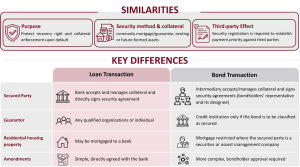
For purposes of this article and to facilitate the analysis, a private placement of corporate bonds is referred to as a “Bond Transaction”, and a borrowing from domestic credit institutions is referred to as a “Loan Transaction”. The key similarities and differences are summarized in the table below.
- Similarities between security arrangements in a Bond Transaction and a Loan Transaction
Security arrangements, either in a Bond Transaction or a Loan Transaction, share the same following characteristics:
a. Purpose and scope of security
Security is a common requirement imposed by creditors in capital-raising transactions to guarantee their lawful interests and capital recovery. Accordingly, if an obligor breaches an agreement, instead of relying solely on its good-faith cooperation to remedy the breach, the creditor is still able to proactively and promptly recover its interests through enforcement of the collateral.
The secured obligations may comprise part or all of the payment obligations of the borrower/issuer, whether existing or arising in the future.
b. Forms of security and collateral
There is various security measures permitted under the Civil Code, but in practice the most commonly used by the parties are mortgages and guarantees. Collateral may be owned by the obligor or a third party, may be existing or future-formed assets, and may comprise movable property, immovable property or property rights.
c. Establishment and maintenance of effectiveness against third parties
The creation of security is typically accompanied by a requirement to register the security in order to establish effectiveness against third parties, thereby protecting the secured party’s highest-ranking priority. The parties may agree that one asset secures multiple obligations, subject to certain conditions, for example only within the scope of other transactions contemplated in advance by the parties or approved in writing by the other party.
d. Enforcement of collateral
If the obligor fails to perform, or improperly or incompletely performs, obligations that have become due, the collateral may be enforced by the secured party at its own discretion through methods provided by law or agreed by the parties, such as an auction sale or a sale under an agreement, appropriation of the collateral by the secured party in substitution for performance of the security provider’s obligation, or other methods. Where enforcement is required, the secured party usually has full discretion to determine the most effective and expeditious way to recover its granted capital because the obligor has by then breached the agreement.
- Key differences between security arrangements in a Bond Transaction and a Loan Transaction
Despite the similarities listed above, security arrangements established for each of these transactions have significant differences as set out below:
a. Secured party
In a Loan Transaction, the bank is the lender and is also the party that receives and manages the collateral. By contrast, in a Bond Transaction, the bondholders are the creditors but do not by themselves receive and manage the collateral. Instead, the collateral is received by the bondholders’ representative or another organization appointed by the bondholders’ representative (where the bondholders’ representative is not permitted to receive and manage the collateral). In practice, securities companies commonly act as the collateral agent assuming the roles of receiving and managing collateral.
This stems from the nature of each transaction. In a Loan Transaction, the lenders are identified and fixed, whereas a Bond Transaction may involve a dispersed group of bondholders, including both organizations and individuals. Moreover, bondholders may change constantly by ownership transfer through ways such as selling, gift or inheritance. Accordingly, an intermediary is required to centrally receive and enforce the collateral. At the time of issuance, the bondholders’ representative will be the organization receiving and managing the collateral. If the bondholders’ representative is not permitted to receive and manage collateral under specialized law, it will appoint another qualified organization to do so[1]. After the bond issuance, during the life of the bonds, the bondholders may decide to replace the bondholders’ representative and collateral agents in accordance with the bond agreements. This also serves to protect the rights and interests of the bondholders.
According to this structure, the mortgage agreement in a Loan Transaction is executed between the bank and the mortgagor, whereas in a Bond Transaction, the bondholders (the creditors) do not directly execute the mortgage agreements (which would in any event be impracticable because the bondholders cannot yet be identified when the security agreement is signed). However, by the act of purchasing, or otherwise acquiring ownership of the bonds, the bondholders are deemed to have agreed to and accepted the terms of the mortgage agreement.
b. Security provider
In the case of an asset mortgage, both a Bond Transaction and a Loan Transaction require the security provider to be the lawful owner of the relevant asset and to have full rights and authority to enter into the security transaction. The difference, however, lies in guarantees. In a Loan Transaction, the guarantor may be any organization or individual having sufficient financial capacity and ability to perform the guarantee obligations, whether a bank, a parent company or another company willing to guarantee the borrower. By contrast, for a Bond Transaction the guarantor is subject to certain restrictions. In particular, a secured bond is defined as a type of bond that benefits from a payment guarantee issued by a credit institution, foreign bank branch, foreign financial institution or international financial institution, in addition to being secured by assets[2]. Accordingly, it appears that, for a Bond Transaction to be recognized as a secured bond by virtue of a guarantee, the guarantor must be a credit institution (domestic or international). If the guarantee is issued by another organization, such as a parent company, the arrangement may only be treated as an ordinary civil guarantee transaction and the bond may not be classified as a secured bond. Therefore, when arranging a guarantee for a Loan Transaction or a Bond Transaction, the developer should carefully choose an appropriate guarantor.
c. Scope of secured obligations
In a Loan Transaction, the mortgagor secures the borrower’s payment obligations under the facility agreement and the relevant mortgage agreement. In other words, the secured obligations comprise only the borrower’s obligations to the bank, as lender. In a Bond Transaction, however, the developer or issuer not only owes obligations to the bondholders but also to various other parties involved in the Bond Transaction, including the bondholders’ representative, issuance adviser, depository agent, collateral agent, and account management organization. Accordingly, the secured obligations may include not only the issuer’s obligations to pay principal, interest, penalties and damages to the bondholders (although these are the principal obligations), but also the issuer’s payment obligations to the bondholders’ representative, the collateral agent, the adviser and issuing agent, and the account management organization. These organizations also commonly require the same pari passu payment priority as the bondholders.
d. Collateral
The developer/issuer may mortgage property rights arising from the project for a Loan Transaction and a Bond Transaction if the appraised value of such collateral exceeds the aggregate value of the loan and the bonds. In addition, in a Loan Transaction, the developer may mortgage residential real estate (whether existing or to be formed in the future) to the bank because, under applicable law, residential real estate could be mortgaged to the credit institution. Specifically:
Under the Law on Housing[3], a developer of a housing construction investment project may mortgage all or part of the project, or mortgage housing constructed within the project, to a credit institution operating in Vietnam in order to borrow capital for investment in and construction of that project or housing; the mortgage of the project or housing must also include a mortgage over the land use rights.
However, it should also be noted that under this provision, securities companies or collateral agents may not be allowed to accept a mortgage over housing in the project. Accordingly, the scope of collateral available for a Bond Transaction and a Loan Transaction will not be entirely identical.
For other types of real estate that are not housing, there appears to be no such restriction. Under the Land Law, an economic organization that is allocated land or leased land with land rent paid in a lump sum for the entire lease term has the right to mortgage its land use rights and assets attached to land owned by it to credit institutions licensed to operate in Vietnam, other economic organizations or other individuals[4]. Similarly, an organization leasing land from the State with annual land rent payments may mortgage assets attached to land and owned by it to credit institutions licensed to operate in Vietnam, other economic organizations or other individuals[5].
Accordingly, issuers/developers should choose an appropriate type of collateral for mortgages in favor of banks and in favor of non-credit institutions such as securities companies or asset management companies.
e. Management and control of collateral
The collateral management and control mechanism is designed to restrict the mortgagor’s rights to use and dispose of the collateral in a way that could adversely affect the collateral’s value or enforceability or recoverability. In a Bond Transaction, the mortgagee generally applies measures similar to those used in a Loan Transaction, including: (i) registering the security over the collateral; (ii) requiring the mortgagor to deliver title and other documents relating to the collateral for retention and management by the secured party; (iii) requiring all cash flows relating to the collateral to pass through an account designated by the mortgagee; and (d) requiring additional collateral if the value of the collateral falls below a prescribed threshold. The key difference, however, is that in a Loan Transaction the management and control of the collateral are carried out by the mortgagee itself, whereas in a Bond Transaction collateral management involves multiple parties, with the collateral agent playing the principal role and the account management organization supporting the management of bond debt-service cash flows and receipts and payments relating to the collateral.
As a result, a Bond Transaction involves multiple agreements, not only a mortgage agreement but also a collateral management agreement and an account management agreement. The collateral management agreement sets out the core principles for managing bond collateral, such as valuation of collateral, addition, replacement and sharing of collateral, and allocation of proceeds from enforcement of collateral. This agreement remains in place throughout the life of the bonds and applies not only to collateral provided by the existing security provider but also to collateral provided by any future security provider, if any. In that case, the new security provider will generally execute a document agreeing to all terms of the pre-existing collateral management agreement. The mortgage agreement sets out details of the collateral, the secured obligations, collateral enforcement events and the enforcement mechanism. The account management agreement governs the management of receipts and payments through accounts linked to the project operations and the use of the bond account. Accordingly, negotiation of the security agreements in a Bond Transaction usually takes longer and is more complex because multiple parties are involved and numerous restrictive provisions apply.
f. Collateral sharing mechanism
In a Bond Transaction, an important aspect of the security agreement is the collateral sharing mechanism. Accordingly, if prior to the bond issuance the asset has already been mortgaged for a loan, this should be clearly stated in the bond security agreement. If no mortgage has yet been created for the Loan Transaction, the bond security agreement should nevertheless permit the mortgagor to use the collateral to secure other obligations, provided that the value of the collateral remains greater than the aggregate value of the bond obligations and the loan obligations. This contingency provision gives the parties greater flexibility and allows optimal use of the collateral without the arrangement being treated as an amendment to the security agreement. Otherwise, the parties would need to seek and obtain bondholder approval as discussed in item (h) below.
In a Loan Transaction, banks generally take a more restrictive approach by prohibiting the collateral from being used to secure other obligations unless the bank gives its prior written consent. Accordingly, where a mortgage agreement has already been entered into with a bank, the issuer/developer should obtain the bank’s written consent permitting the mortgaged asset to secure the bond obligations as well.
g. Collateral enforcement mechanism
In a Loan Transaction, when a default occurs that triggers enforcement of the collateral, the bank, as secured party, acts on its own and determines the manner, method and sequence of enforcement in accordance with the agreement. Because the bank has full discretion to make decisions and carry out the enforcement, the process can be completed relatively quickly.
In a Bond Transaction, enforcement of collateral involves multiple parties, including the bondholders’ representative, the secured party and the account management organization. Accordingly, upon the occurrence of a collateral enforcement event specified in the security agreement, the bondholders’ representative notifies the secured party. Upon receipt of such notice, the secured party carries out the enforcement steps, including requesting the account management organization to freeze the relevant account and debit funds of the security provider in accordance with the account management agreement.
For a standalone transaction, collateral enforcement is usually relatively straightforward because the parties have agreed on the coordination and enforcement mechanism in the relevant agreements. The issue becomes considerably more complex where the collateral simultaneously secures both a loan and bonds. In that case, the relevant parties should consider the following matters:
- First, the payment priority of each obligation. This depends on the parties’ agreement and the transaction structure. In line with market practice, the approach is that the obligations rank equally in all respects and that the proceeds from enforcement of the collateral are allocated concurrently to each secured party on a pro rata basis, calculated according to the outstanding amount of each obligation and the total outstanding amount of all obligations. In certain special circumstances, the bank may require the loan to rank ahead of the bonds (because it was established earlier, or the loan amount is larger, or for other commercial reasons). In that case, the parties should consider the amount payable to the bank to ensure that the bond obligations can also be paid, thereby protecting the interests of the bondholders.
- Second, the event triggering enforcement of the collateral. Specifically, may enforcement of the collateral under the Loan Transaction trigger enforcement under the Bond Transaction and vice versa? Because the same collateral is mortgaged simultaneously for both transactions and cannot be separated into independent portions, a prudent approach is generally that enforcement under one transaction should trigger enforcement under the other transaction.
- Third, the process and procedures for enforcement of the collateral. If the Loan Transaction occurs after the Bond Transaction, the commonly applied mechanism is that (i) either the organization receiving the bond collateral or the bank may authorize the other party to carry out the enforcement of the collateral, and (ii) the loan agreement should contain collateral enforcement principles similar to those in the bond secßurity agreement. Conversely, if the Loan Transaction occurs before the Bond Transaction, the bank will generally require collateral enforcement to follow the bank’s procedures in order to preserve the bank’s control, while also providing a mechanism for allocating proceeds to the organization receiving the bond collateral. This requires the developer to work closely with the relevant parties, including the bank and the organization receiving the bond collateral, to ensure that the collateral enforcement mechanism is applied consistently and to avoid conflicts or overlaps.
h. Amendment of security agreements
For a Loan Transaction, amending the terms and conditions of the security agreement is relatively simple and convenient. The bank and the mortgagor discuss the required amendments and execute an amendment agreement.
For a Bond Transaction, amendments to the security agreement generally require bondholder approval, except for non-material changes that are formal or technical in nature and matters expressly specified by the parties as not requiring bondholder approval, provided that they do not affect the rights and interests of the bondholders. The method and process for soliciting bondholder opinions and the approval threshold are set out in the bond issuance plan[6]. As a matter of market practice, the parties generally apply to matters relating to bond security the same approval threshold as that applicable to changes to the fundamental terms and conditions of the bonds, such as tenor, issuance amount and face value, i.e. approval by bondholders representing at least 65% of the total outstanding bonds of the same type[7].
Although both are based on the general principles of Vietnamese law on secured transactions, security in a Bond Transaction is designed for a multi-party capital-raising structure with high transferability, whereas security for a loan is designed around the direct credit relationship between the borrower and the lender. Identifying these differences correctly will therefore help the parties develop appropriate transaction documentation and collateral management mechanisms.
———
[1] Article 11.6 of Decree No. 200/2026/ND-CP of the Government dated 5 June 2026 prescribing private placement and trading of privately placed corporate bonds in domestic market and offering of corporate bonds in international market (“Decree 200“).
[2] Article 4.4 and Articles 14.10 of Decree 200.
[3] Article 181 of the Law on Housing.
[4] Article 33 of the Land Law.
[5] Article 34 of the Land Law.
[6] Article 10.1(k) of Decree 200.
[7] Article 5.4(b) and Article 6 of Decree 200.
Disclaimer: This article has been prepared by PTN Legal LLC (‘PTN Legal‘) for the sole purpose of providing reference information to readers. PTN Legal makes no representation or warranty as to the accuracy or completeness of this information. The contents of this article may be changed, amended, or updated without prior notice. PTN Legal assumes no responsibility for any errors or omissions in this article, or for any damage arising from the use of this article in any circumstances. Please visit PTN Legal’s website to view our previous articles here.
Readers who wish to receive articles from PTN Legal by email may register their information here.
This Article was prepared by Yen Pham, Senior Associate