



Against the backdrop of tax authorities increasingly tightening tax administration concerning transfer pricing and base erosion, it has become increasingly imperative for enterprises to accurately identify related party transaction (“RPT”) and fully comply with relevant statutory regulations.
In practice, many enterprises still maintain the misconception that RPTs exclusively occur between a parent company and its subsidiaries, or among entities within the same corporate group. However, pursuant to current regulations, RPTs are determined based on a variety of criteria groups, including: (i) equity ownership or capital contribution relationships; (ii) borrowing, lending, or financial guarantee relationships; (iii) management, direction, or control relationships; (iv) familial relationships among corporate executives, among others;… Consequently, a significant number of enterprises may inadvertently engage in RPTs in practice without realizing it. Such transactions entail numerous associated obligations, notably tax obligations. Given the inherent complexity of RPTs, enterprises must manage extensive documentation and compliance procedures. At the same time, failure to comply with regulations harbors critical risks, including the disallowance of deductible expenses or statutory tax assessments by tax authorities.
In this article, we will synthesize the criteria for determining RPTs under current regulations while highlighting the critical tax obligations that enterprises must note to proactively ensure compliance and mitigate potential legal risks.
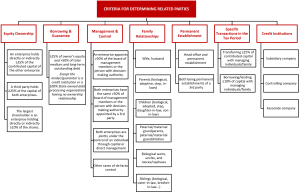
(Overview diagram of the criteria for determining related parties by principal categories)
1. Identification of “Related-party transactions”
Pursuant to Article 4.1 of Decree 255[1]: “RPTs are transactions involving the purchase, sale, exchange, lease, renting, borrowing, lending, transfer, and assignment of goods or the provision of services; borrowing, lending, financial services, financial guarantees, and other financial instruments; purchase, sale, exchange, lease, renting, borrowing, lending, transfer, and assignment of tangible and intangible assets; and agreements on the purchase, sale, or joint utilization of resources such as assets, capital, labor, or cost-sharing between related parties, excluding business transactions involving goods and services that fall under the State’s pricing regulation scope, which shall be carried out in accordance with the law on pricing.”
Accordingly, parties are deemed to have a related-party relationship in the following cases[2]:
a. An enterprise directly or indirectly holds at least 25% of the contributed owner’s equity of the other enterprise;
b. Both enterprises have at least 25% of their contributed owner’s equity directly or indirectly held by a third party;
c. An enterprise is the largest shareholder in terms of contributed owner’s equity and directly or indirectly holds at least 10% of the total shares of the other enterprise;
d. An enterprise guarantees or lends capital to another enterprise under any form (including loans from third parties guaranteed by the financial resources of a related party and financial transactions of a similar nature), provided that the total outstanding loan balance of the borrowing enterprise owed to the lending or guaranteeing enterprise equals at least 25% of the borrowing enterprise’s contributed owner’s equity and accounts for over 50% of the borrowing enterprise’s total outstanding medium and long-term debts;
Except for the following cases: (i) The guarantor/lender is a credit institution and does not have a related-party relationship with the borrower/guaranteed party under any of the remaining cases; or (ii) The creditor/guarantor is an institution of which 100% of the charter capital is owned by the State, tasked with the function of debt trading and resolution, and which neither directly nor indirectly holds at least 25% of the contributed owner’s equity, nor is the largest shareholder directly or indirectly holding at least 10% of the total shares of the debtor/guaranteed enterprise;
e. An enterprise appoints members of the executive board of management or assumes control of another enterprise, provided that the number of members appointed by the first enterprise accounts for more than 50% of the total members of the executive board of management or the controlling body of the second enterprise; or one member appointed by the first enterprise has the right to decide on the financial policies or business operations of the second enterprise;
f. Both enterprises have more than 50% of their board of management members, or have one board of management member with the right to decide on financial policies or business operations, appointed by a third party;
Both enterprises are managed or controlled in terms of personnel, finance, and business operations by individuals who fall into one of the following familial relationships:
- wife, husband;
- biological parents, adoptive parents, stepfather, stepmother, parents-in-law;
- biological children, adopted children, stepchildren, daughters-in-law, sons-in-law;
- siblings sharing the same parents, half-siblings sharing either the same father or the same mother, brothers-in-law, or sisters-in-law of full siblings or half-siblings;
- paternal grandparents, maternal grandparents;
- paternal grandchildren, maternal grandchildren; or
- aunts, uncles, and biological nieces/nephews;
h. Two business establishments have a head office and permanent establishment relationship, or both are permanent establishments of a foreign organization or individual;
i. Enterprises are under the control of an individual through this individual’s capital contribution to the enterprise or their direct participation in the management of the enterprise;
j. Other cases in which an enterprise (including independently accounting branches that declare and pay corporate income tax) is, in practice, under the management, control, or decision-making authority regarding its production and business operations by the other enterprise;
k. An enterprise engages in transactions involving the transfer or receipt of a transfer of capital contributions equivalent to at least 25% of the enterprise’s contributed owner’s equity within the tax period; or borrowing, lending, borrowing of assets, or lending of assets equivalent to at least 10% of the contributed owner’s equity at the time the transaction arises within the tax period with an individual who manages or controls the enterprise, or with an individual who falls under one of the relationships specified in point (g) of this clause;
l. A credit institution with its subsidiary, controlling company, or associated company of the credit institution as prescribed by law.
2. Obligations to be fulfilled when RPTs arise
One of the most fundamental principles that enterprises must observe upon engaging in RPTs is the mandatory application of measures to eliminate factors that reduce tax obligations caused or influenced by the related-party relationship. This is to ensure the declaration and determination of tax obligations for RPTs are equivalent to those of independent transactions under comparable conditions.
Accordingly, enterprises are required to fulfill the following specific obligations:
2.1. Declaration of information on RPTs
a. Timing of execution: To be submitted concurrently with the annual Corporate Income Tax (“CIT“) finalization return.
b. Content of declaration: In accordance with the forms including Appendix I, Appendix II, and Appendix III promulgated in conjunction with Decree 255:
(i) Appendix I: Information on related-party relationships and RPTs:
- Information on related parties;
- Information on cases eligible for exemption from declaration and exemption from the preparation of transfer pricing documentation;
- Information on the determination of RPT prices (transfer pricing);
- Information on production and business results following the determination of RPT
(ii) Appendix II: List of information and documents to be provided in the local file.
(iii) Appendix III: List of information and documents to be provided in the master file.
Note: Enterprises engaging in RPTs that fail to fulfill the aforementioned declaration requirements may be subject to a monetary fine ranging from VND 8 – 15 million in accordance with statutory regulations[3].
2.2. Preparation of transfer pricing documentation:
a. Timing of preparation: Prior to the time of filing the annual CIT finalization return, the documentation must be maintained and presented upon the request for information provision by the tax authority.
b. Content of the documentation: Comprises detailed information, documents, data, and supporting records corresponding to Appendix I, Appendix II, Appendix III, and Appendix IV promulgated in conjunction with Decree 255:
- Information on related-party relationships and RPTs;
- Local file in accordance with the prescribed list of information and document contents;
- Master file in accordance with the prescribed list of information and document contents;
- Country-by-country report of the Ultimate Parent Company for prescribed cases, such as: the enterprise is the Ultimate Parent Company in Vietnam, or has an overseas Ultimate Parent Company with a global consolidated revenue in the financial year immediately preceding the reporting year equivalent to EUR 750 million or more.
c. Data, supporting records, and documents used as the basis for the analysis, comparability, and determination of RPT prices must clearly state their sources of origin. In cases where the data of independent comparables consist of accounting figures, the taxpayer is responsible for storing and providing them to the tax authority in soft copy, using a spreadsheet format.
Additionally, enterprises should be aware that for RPTs which concurrently qualify as transactions with related persons pursuant to the Law on enterprises, the enterprise must execute the required procedures for transaction approval/ratification in accordance with the provisions of the Law on Enterprises.
- Cases eligible for exemption from declaration and exemption from the preparation of transfer pricing documentation
As stated in section 2 above, enterprises engaging in RPTs bear the responsibility of declaring information on RPTs and preparing transfer pricing documentation.
However, in certain cases outlined below, enterprises with RPTs are exempted from declaring specific information on RPTs in Appendix I or exempted from preparing transfer pricing documentation. Nevertheless, the enterprise must still determine the total deductible interest expenses when determining taxable corporate income for enterprises with RPTs in accordance with regulations, specifically:
3.1. An enterprise is exempted from declaring information on the determination of RPT prices and information on production and business results following the determination of RPT prices in Appendix I in the following case: the enterprise solely engages in transactions with related parties that are CIT taxpayers in Vietnam, are subject to the same CIT rate as the enterprise, and neither party is entitled to CIT incentives during the tax period.
3.2. Enterprises are exempted from preparing transfer pricing documentation in the following cases:
a. Case 1: The enterprise engages in RPTs, but its total revenue generated within the tax period is under VND 50 billion, and the total value of all RPTs arising within the tax period is under VND 30 billion;
b. Case 2: The enterprise has entered into an Advance Pricing Agreement (APA) and has submitted the annual report in accordance with statutory regulations on APAs. For RPTs falling outside the applicable scope of the APA, the taxpayer remains responsible for declaring and determining the RPT prices as prescribed;
c. Case 3: The enterprise does not generate revenue or incur expenses from the exploitation or utilization of intangible assets, has a revenue of under VND 500 billion, and applies a ratio of net profit before interest expense and corporate income tax (excluding differences in revenue and expenses from financial activities) to net revenue, encompassing the following sectors:
(i) Distribution: 5% or more;
(ii) Manufacturing: 10% or more;
(iii) Processing: 15% or more.
Notes for this case:
- If the enterprise separately tracks and accounts for the revenues and expenses of each business sector, it shall apply the ratio of net profit before interest expense and CIT to the net revenue corresponding to each specific sector.
- If the enterprise can separately track and account for revenues but cannot separately track and account for the incurred expenses of each sector within its production and business operations, it shall allocate expenses in proportion to the revenue of each sector in order to apply the ratio of net profit before interest expense and CIT to the net revenue corresponding to each sector.
- If the enterprise cannot separately track and account for the revenues and expenses of each production and business sector to determine the ratio of net profit before interest expense and CIT corresponding to each sector, it shall apply the ratio of net profit before interest expense and CIT to the net revenue of the sector subject to the highest prescribed ratio.
- In the event the enterprise does not apply the net profit ratios prescribed in this point, it is required to prepare transfer pricing documentation in accordance with statutory regulations.
- Determination of deductible expenses for tax purposes for enterprises engaging in RPTs
Enterprises engaging in RPTs must note the following matters when determining their deductible expenses for tax purposes:
4.1. Enterprises are not permitted to include in their deductible expenses when determining the taxable corporate income for the period the expenses of RPTs that do not conform to the nature of independent transactions, or that do not contribute to the generation of revenue and income for the enterprise’s production and business activities, including:
a. Expenses paid to a related party that does not perform any production or business activities related to the industry, production, or business operations of the enterprise; or that holds no associated rights or responsibilities with respect to the assets, goods, or services provided to the enterprise;
b. Expenses paid to a related party that performs production or business activities, but whose asset scale, number of employees, and production and business functions are disproportionate to the transaction value that the related party receives from the enterprise;
c. Expenses paid to a related party that is a resident of a country or territory that does not levy corporate income tax, and that does not contribute to the generation of revenue or value-added for the taxpayer’s production and business activities.
4.2. With respect to service expenses from related parties:
a. The enterprise is permitted to claim such expenses as deductible expenses for tax purposes in the period, provided that the following conditions are fully satisfied:
- the provided services possess commercial, financial, and economic value, and directly serve the enterprise’s production and business activities.
- the services from related parties are determined to have been provided under comparable circumstances wherein independent parties would pay for such services.
- the service fees are paid on the basis of the arm’s length principle, and the transfer pricing method or the method of allocating service fees among related parties must be applied consistently across the group for similar types of services. Furthermore, the enterprise must provide contracts, supporting documents, invoices, and information concerning the calculation method, allocation factors (allocation keys), and the group’s pricing policy for the services provided.
- In case the RPTs involve centers performing specialized functions and creating synergistic added value for the group, the enterprise must determine the total value generated by such functions and determine a profit allocation proportionate to the contributed value of the related parties, after deducting (-) a corresponding service fee for the related party executing the coordination and service-provision functions in comparable independent transactions.
b. The enterprise is not permitted to claim as deductible expenses for tax purposes in the period with respect to:
- expenses arising from services provided solely for the purpose of serving the interests of, or creating value for, other related parties;
- services serving the shareholder interests of related parties;
- services subject to duplicative fees provided by multiple related parties for the same type of service, for which no value-added for the taxpayer can be determined;
- services which, by their nature, constitute benefits received by the taxpayer as a result of being a member of a corporate group; and costs added (mark-ups) by a related party for services provided by a third party through the related party acting as an intermediary that do not contribute additional value to the services.
4.3. With respect to interest expenses:
a. The total interest expense, after deducting interest on deposits and lending interest incurred in the period by the taxpayer, that is deductible when determining taxable corporate income shall not exceed 30% of the total net profit from business activities in the period plus the interest expense (after deducting interest on deposits and lending interest incurred in the period) plus depreciation and amortization expenses incurred in the period by the taxpayer;
Exceptions: Loans of credit institutions and insurance business organizations; Official Development Assistance (ODA) loans, preferential loans of the Government implemented under the mechanism whereby the Government borrows from foreign sources and on-lends to enterprises; loans for the implementation of national target programs (new rural development and sustainable poverty reduction programs); and loans for investment in programs and projects implementing the State’s social welfare policies (resettlement housing, housing for workers and students, social housing, and other public welfare projects);
b. The portion of interest expense that is non-deductible pursuant to the above provision shall be carried forward to the subsequent tax period when determining the total deductible interest expense, provided that the total deductible interest expense incurred in the subsequent tax period is lower than the prescribed cap. The continuous carry-forward period for interest expenses shall not exceed 05 years, commencing from the year following the year in which the non-deductible interest expense was incurred;
c. The enterprise must declare the ratio of interest expenses within the tax period in accordance with Appendix I promulgated in conjunction with Decree 255.
5. Cases subject to tax assessment for enterprises engaging in RPTs
In the event an enterprise engages in RPTs but fails to comply with the regulations on the declaration and determination of RPTs; or fails to provide, or provides incomplete information and data for the declaration and determination of RPT prices, the tax authority may implement tax assessment measures. These measures include: assessing the price level; assessing the profit margin; assessing the profit allocation ratio; assessing the taxable income; or assessing the payable CIT amount.
Specifically, this applies to the following cases:
a. The taxpayer fails to declare, declares incomplete information, declares incorrect information, or fails to submit Appendix I promulgated in conjunction with Decree 255;
b. The taxpayer provides incomplete information in the Transfer Pricing Documentation as prescribed in Appendix II and Appendix III promulgated in conjunction with Decree 255; or fails to present the Transfer Pricing Documentation alongside the data, supporting records, and documents used as the basis for the analysis, comparability, and price determination within the Transfer pricing documentation upon the request of the tax authority within the prescribed time limit;
c. The taxpayer utilizes untruthful or inaccurate information regarding independent transactions for the purpose of analysis, comparability, and declaration of RPT prices; or relies on illegal or invalid documents, data, and supporting records, or fails to clearly state their sources of origin to determine the price level, profit margin, or profit allocation ratio applicable to the RPTs;
d. The taxpayer commits violations of the regulations on determining RPT prices in cases eligible for exemption from declaration or exemption from the preparation of Transfer pricing documentation.
In the event of being subject to a tax assessment, the enterprise may also be subject to administrative penalties for false declaration, carrying a monetary fine of up to 20% of the under-declared tax amount or the tax amount that was exempted, reduced, or refunded in excess of statutory regulations.
———-
[1]Decree No. 255/2026/ND-CP dated 30 June 2026 of the Government on tax management for RPTs entered into by enterprises having related party relationships (“Decree 255”).
[2] Article 5.2, Decree 255.
[3] Article 13.4.d Decree No. 125/2020/ND-CP dated 19 October 2020 of the Government prescribing administrative penalties for tax and invoice-related violations.
———-
Disclaimer: This article has been prepared by PTN Legal LLC (‘PTN Legal’) for the sole purpose of providing reference information to readers. PTN Legal makes no representation or warranty as to the accuracy or completeness of this information. The contents of this article may be changed, amended, or updated without prior notice. PTN Legal assumes no responsibility for any errors or omissions in this article, or for any damage arising from the use of this article in any circumstances. Please visit PTN Legal’s website to view our previous articles here.
Readers who wish to receive articles from PTN Legal by email may register their information here.
This article was prepared by Ha Tu, Counsel