



Against the backdrop of increasing socialization of public service provision, joint venture and business cooperation agreements between private investors and public service units (“PSUs”) are becoming an inevitable trend. This combination offers mutual benefits: the public sector can leverage private capital and management expertise, while the private sector can access the State’s existing infrastructure and reputation. However, unlike ordinary commercial transactions between independent enterprises, cooperation with a public-sector organization requires investors to understand and comply with the legal framework governing PSUs, particularly the laws on public asset management and financial autonomy mechanisms.
This article focuses on key legal issues that investors should consider when conducting business cooperation with PSUs through joint ventures and business cooperation arrangements. It aims to provide investors with an overview of the legal process for such transactions, from determining eligibility to participate in the cooperation and completing the necessary approval procedures, through to structuring, executing and implementing the joint venture or business cooperation arrangement in practice. On that basis, the general legal process for entering into a joint venture or business cooperation arrangement with a PSU may be summarized as follows:
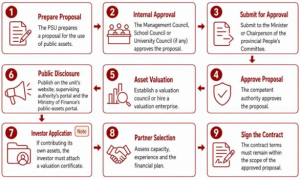
- Forms of using public assets for joint ventures and business cooperation by PSUs
Under current law, PSUs may use public assets for joint ventures and business cooperation in the following forms:[1]
- A joint venture or business cooperation arrangement without establishing a new legal entity, under which the parties use their own assets to carry out the joint venture or business cooperation activities; each party manages and uses its own assets, bears its own costs arising during the course of operations, and shares the results of the joint venture or business cooperation activities in accordance with the contract;
- A joint venture or business cooperation arrangement without establishing a new legal entity, under which the parties jointly contribute assets or capital to invest in the construction or purchase of assets used for the joint venture or business cooperation purposes; the management and use of such assets are jointly controlled by the parties;
- A joint venture or business cooperation arrangement involving the establishment of a new legal entity, under which the parties jointly contribute assets or capital to invest in the construction or purchase of assets used for the joint venture or business cooperation purposes; the new legal entity is responsible for managing and using the assets in accordance with law and the joint venture or business cooperation agreement.
Accordingly, the choice of joint venture or business cooperation form will determine the mechanisms for asset management, cost allocation, operational control and distribution of business results among the parties under the joint venture or business cooperation agreement.
- PSUs’ right to participate in joint ventures and business cooperation
Pursuant to Article 25.1 of Government Decree No. 60/2021/ND-CP dated 21 June 2021 on the financial autonomy mechanism applicable to public service units (“Decree 60”), PSUs have autonomy and are responsible for entering into joint ventures and business cooperation arrangements with organizations and individuals to provide services that meet social needs. However, the procedures for carrying out such activities vary to some extent depending on the PSU’s level of financial autonomy. Accordingly, pursuant to Article 9 of Decree 60, PSUs are classified into four groups based on their level of autonomy, as summarized below:
- Group 1: Units that self-finance 100% or more of their recurrent expenditures and whose level of self-financing for investment expenditures is at least equal to the amount of depreciation of fixed assets;
- Group 2: Units that self-finance 100% or more of their recurrent expenditures but are not yet able to self-finance investment expenditures from funds and lawfully retained revenues;
- Group 3: Units with revenues but whose self-financing of recurrent expenditures ranges from 10% to less than 100% (based on service prices that do not yet fully account for costs); and
- Group 4: Units whose recurrent expenditures are funded by the State (the lowest level of autonomy).
The above classification is important because it reflects the degree of a unit’s dependence on the State budget, its ability to generate and use revenues, and its discretion in certain financial and expenditure decisions. Units with a high level of autonomy generally have greater flexibility in generating revenues, balancing their finances, organizing their operations and performing the financial obligations arising from a transaction. By contrast, for PSUs with a low level of autonomy, particularly Group 4 units, the law imposes greater restrictions on the resources that may be committed to joint venture or business cooperation activities, the recognition of revenues and expenses arising from the cooperation, and the management and use of the financial results allocated to the PSU.
From an investor’s perspective, identifying the PSU’s financial autonomy group is one of the matters that should be considered before participating in the partner selection process described in Section 5. This enables the investor to assess the feasibility and efficiency of the proposed cooperation, the scope of resources that the PSU may mobilize, and the financial and result-sharing mechanisms applicable to the joint venture or business cooperation agreement.
- Conditions and procedures for PSUs to use public assets for joint ventures and business cooperation
Where assets managed by a PSU are to be used for joint venture or business cooperation activities, the resources proposed to be contributed to the arrangement must be clearly identified. In practice, a PSU’s contribution may include rights to exploit premises, public service facilities, machinery, equipment, information technology systems, intellectual property, brands or other assets under its management. In the healthcare sector, such resources may include examination and treatment areas, functional rooms, medical machinery and equipment, technical infrastructure systems or assets directly serving professional activities. Where such resources constitute public assets and are used for business cooperation, the transaction must be considered under the legal regime governing the use of public assets for joint venture and business cooperation purposes[2].
The 2017 Law on Management and Use of Public Assets sets out a range of requirements for using public assets for business, leasing, joint venture and business cooperation purposes. In principle, such use must not affect the performance of functions and duties assigned by the State; must not result in the loss of ownership of public assets; must ensure the preservation and development of assets and State capital allocated to the unit; must use assets for the proper purposes and consistently with the unit’s functions and duties; must maximize capacity and efficiency of use; must fully perform financial obligations; and must comply with market mechanisms and other relevant laws.
On that basis, the law expressly requires a PSU that uses public assets for joint venture or business cooperation purposes to prepare a Scheme for the use of public assets for joint venture or business cooperation purposes and submit it to the competent authority or person for approval in accordance with the laws on management and use of public assets. If the unit has a Management Council, School Council or University Council, it must report the Scheme to the relevant council for approval before submitting it to the competent authority[3]. In practice, determining the competent approving authority requires not only consideration of general legal provisions but also a review of relevant decentralization, delegation and autonomy instruments issued by competent authorities, such as decisions of provincial-level People’s Committees or People’s Councils. The PSU’s partner selection process and the subsequently executed joint venture or business cooperation agreement must be consistent with the Scheme and the relevant approvals.
From an investor’s perspective, before participating in the partner selection process described in Section 5, the investor should carefully review the Scheme, the approval decision and publicly disclosed information on the proposed joint venture or business cooperation arrangement in order to assess the scope of assets proposed for use, the legal basis of the proposal and the feasibility of the cooperation model. Once selected as a partner, the investor should ensure that the joint venture or business cooperation agreement is negotiated and executed consistently with the Scheme, the partner selection results and the relevant approvals.
- Determining the value of a PSU’s capital contribution under a joint venture or business cooperation agreement
After the Scheme for the use of public assets for joint venture or business cooperation purposes is approved, the PSU is responsible for making a specific decision on the use of public assets for such purposes and for establishing a Valuation Council in accordance with the laws on prices or engaging a valuation enterprise to determine the value of the public assets used in the joint venture or business cooperation arrangement[4]. For each type of asset treated as a capital contribution under the joint venture or business cooperation agreement, the asset value must be determined in accordance with the following principles[5]:
- Land use rights: Determined based on market value at the time of capital contribution;
- Land-attached assets: Determined based on their actual remaining value following revaluation at the time of capital contribution;
- A PSU’s brand: Valued in accordance with Vietnamese Valuation Standards;
- Other contributed assets: Determined based on the market value, at the time of the joint venture or business cooperation, of assets of the same type or assets with the same technical standards, quality and origin.
In addition, capital contributions in this case must comply with specialized laws on land, intellectual property, enterprises, etc[6].
- Conditions applicable to investors participating in joint venture or business cooperation agreements with PSUs
It should be noted that an investor is not automatically selected as a partner merely because the parties wish to cooperate; rather, the investor must participate in the partner selection process prescribed by the laws on management and use of public assets. Accordingly, after a competent authority or person issues a decision on the use of public assets for joint venture or business cooperation purposes, the PSU must publicly announce the selection of a joint venture or business cooperation partner on the unit’s website (if any), the web portal of the relevant ministry, central agency or locality, and the Ministry of Finance’s public asset website[7]. The public announcement on partner selection must contain the following principal information:
- Information on the unit holding the assets to be used for the joint venture or business cooperation;
- Assets proposed for the joint venture or business cooperation;
- The joint venture or business cooperation plan;
- Criteria for selecting the joint venture or business cooperation partner;
- Time and place for submission of registration
Based on the public announcement, an investor wishing to participate in the joint venture or business cooperation must submit a registration dossier to the PSU, which will then conduct the partner selection process. The PSU is responsible for its selection[8]. If the investor uses its own assets as a capital contribution to a joint venture or business cooperation arrangement with the PSU, the investor must engage a valuation enterprise to determine the value of those assets before submitting its registration dossier[9]. To be selected, the investor must satisfy the partner selection criteria, including capacity, experience, effectiveness of the financial plan, facilities for implementing the joint venture or business cooperation, the asset disposal plan, and other criteria consistent with the purposes of the arrangement and the PSU’s functions and duties[10].
- Other considerations for joint ventures and business cooperation with PSUs
In addition to the matters discussed above, private investors participating in joint ventures and business cooperation with PSUs should also consider the following issues:
(i) The joint venture or business cooperation agreement must accurately reflect the approved Scheme for the use of public assets for joint venture or business cooperation purposes
The joint venture or business cooperation agreement should clearly set out the scope of the cooperation activities, the assets and resources provided by each party, the value and method of determining each contribution, the purposes and limitations on the use of public assets, the cooperation term, the governance mechanism, and the principles for distributing financial results, in a manner that accurately reflects the approved Scheme for the use of public assets for joint venture or business cooperation purposes.
For material matters that formed the basis for approval of the Scheme, the joint venture or business cooperation agreement should not grant the parties overly broad amendment rights without appropriate review mechanisms and completion of the necessary approvals. In particular, changes to the assets contributed to the cooperation, the scope of exploitation, purposes of use, term or other material economic mechanisms should be reviewed to determine whether approval is required before such changes take effect.
(ii) Specialized legal responsibilities should be carefully considered
For joint venture or business cooperation activities in specialized sectors, the parties should carefully review sector-specific laws to ensure that the cooperation model fully satisfies all operating conditions and clearly allocates the legal responsibilities of each party. For example, in the medical examination and treatment sector, each medical examination and treatment establishment must hold an operating licence and may operate only within its licensed professional scope. Therefore, where a private investor enters into a joint venture or business cooperation arrangement with a public hospital and the cooperation activities are carried out at the existing public hospital, the parties should assess whether the addition of services, scale, personnel or professional scope triggers a requirement to amend the operating licence. If the activities are conducted at another facility or location, the parties should consider the procedures for obtaining a separate operating licence for that facility. The joint venture or business cooperation agreement should also clearly identify which party is responsible for obtaining a new licence or amending an existing licence, which party will be named on the operating licence, and the responsibilities for maintaining the required facilities, equipment, personnel, practising licences and practice registrations throughout the cooperation term.
(iii) Mechanism for handling assets upon termination of the joint venture or business cooperation agreement
From an investor’s perspective, the mechanism for handling assets upon termination of a joint venture or business cooperation agreement should be considered from the investment structuring stage, particularly where the investor must provide capital to construct, renovate or create assets serving the cooperation activities. Accordingly, land use rights, buildings, structures and other land-attached assets that form part of the assets used in the joint venture or business cooperation and are created through such activities must, upon expiry or termination of the agreement, including early termination, be transferred without compensation to the PSU for management and use[11].
Accordingly, investors should carefully assess capital recovery and payback periods for investments attached to land, buildings or structures of the PSU. For other assets, the handling mechanism depends on the form of joint venture or business cooperation described in Section 1 and may include returning assets to the party that contributed them to the cooperation, dividing newly created assets based on value or contribution ratios, or selling the assets under the applicable valuation or auction mechanism[12]. Therefore, the joint venture or business cooperation agreement should clearly identify from the outset the list and origin of assets, each party’s management and use rights, the principles for division or transfer upon termination, and the mechanism applicable in the event of early termination, in order to mitigate the risk that the investor may be unable to recover its invested capital.
———-
[1] Article 55.4 Decree No. 186/2025/ND-CP of the Government detailing a number of articles of the Law on Management and Use of Public Property dated 1 July 2025 (“Decree 186”).
[2] Article 55.2 Law on Management and use of public property 2017.
[3] Article 25.2 Decree 60 and Article 1.17 Decree No. 111/2025/ND-CP of the Government amending and supplementing a number of articles of Decree 60 dated 22 May 2025.
[4] Article 55.2 Decree 186.
[5] Article 58.3 Law on Management and use of public property 2017.
[6] Article 58.3 Law on Management and use of public property 2017.
[7] Articles 55.2(c) and 55.3 Decree 186.
[8] Articles 55.3(a) Decree 186.
[9] Articles 55.3(a) Decree 186.
[10] Articles 55.3 Decree 186.
[11] Articles 55.6 Decree 186.
[12] Articles 55.6 Decree 186.
————–
Disclaimer: This article has been prepared by PTN Legal LLC (‘PTN Legal‘) for the sole purpose of providing reference information to readers. PTN Legal makes no representation or warranty as to the accuracy or completeness of this information. The contents of this article may be changed, amended, or updated without prior notice. PTN Legal assumes no responsibility for any errors or omissions in this article, or for any damage arising from the use of this article in any circumstances. Please visit PTN Legal’s website to view our previous articles here.
Readers who wish to receive articles from PTN Legal by email may register their information here.
This article was prepared by Thao Vu, Paralegal