



Within the innovation‑driven start‑up ecosystem, private capital fundraising through Series rounds (Seed, Series A, Series B, Series C, etc.) has become a widely adopted international practice. This model enables start‑ups to access capital that aligns with each stage of their development, while allowing investors to allocate and manage risks over time. As Vietnam’s start‑up market continues to expand, an increasing number of Vietnamese start-ups have proactively adopted Series‑based fundraising structures and have recorded multiple successful transactions.
However, implementing Series‑based fundraising within the Vietnamese legal framework presents notable challenges in transaction structuring. The divergence between international market practice and Vietnamese statutory requirements necessitates that companies develop a precise, well‑structured, and legally compliant set of transaction documents to ensure enforceability, mitigate risks, and optimize resources for all parties involved.
This article examines the legal nature of Series‑based fundraising, the current application in Vietnam, the techniques for developing transaction documentation, and the mechanisms for coordinating multiple investors across successive fundraising rounds. The objective is to provide a comprehensive and practical perspective for companies, investors, and other market participants engaging in Vietnam’s start‑up ecosystem when adopting internationally recognized fundraising models within the Vietnamese legal environment.
- Overview of Series-Based Fundraising Transactions
a. Transaction forms
Series-based fundraising refers to the process through which a company (typically an innovative start-up or a high-growth enterprise) raises capital from investors across successive stages of its development. From a legal perspective, Series-based fundraising is not an independent concept under Vietnamese law; rather, it is the aggregation of various mechanisms for capital restructuring and changes in ownership ratios, each of which is directly governed by the Law on Enterprises and other relevant regulations.
In Series-based fundraising, the capital raise may be conducted through a sigle or a combination of the following transactions: (i) an increase of charter capital, (ii) the transfer of existing equity interests, and (iii) the use of convertible debt instruments.

(i) Increase of Charter Capital (Primary Transaction): In essence, Series-based fundraising constitutes an increase of charter capital through the contribution of funds by existing investors or new investors. Depending on the type of enterprise, the increase of charter capital may be implemented through different mechanisms:
- Joint Stock Company: The company may offer shares to existing shareholders, together with an offering to new investors in cases where existing shareholders do not exercise or fully exercise their pre-emptive rights[1]; or may conduct a private placement of shares[2].
- Limited Liability Company: The company may increase the capital contributions of existing members or admit new members whose capital contributions result in an increase of charter capital[3].
Under this mechanism, the investment proceeds are injected directly into the company to support business expansion, research and development, or working capital needs. The issuance price of new shares or capital contributions is typically determined based on the company’s valuation and may be significantly higher than the par value or the value recorded in the enterprise registration documents. The difference between the actual issuance price and the par value/value of capital contribution is recorded as capital surplus in accordance with accounting and financial regulations.
(ii) Transfer of Existing Equity Interests (Secondary Transaction): In a secondary transaction, the investor acquires shares or capital contributions directly from existing shareholders, founding members, or earlier-round investors seeking to divest. This type of transaction does not alter the company’s charter capital but affects the ownership structure. Secondary transfers are commonly used when a company seeks to attract strategic investors who can provide resources, management expertise, or business networks; or when investors wish to acquire equity in a high-growth company at a time when the company does not intend to expand its charter capital or has recently completed a capital increase.
(iii) Use of Convertible Debt Instruments:
In early stages when the company’s revenue model is not yet fully established or parties find it difficult to agree on valuation, fundraising may be structured through flexible financial instruments such as Convertible Notes or SAFE agreements (Simple Agreement for Future Equity). Under Vietnamese law, these instruments may be implemented through:
- Issuance of convertible bonds, applicable to companies that meet statutory conditions[4]; or
- Uoan transactions [5] accompanied by an option agreement granting the lender the right to purchase shares or capital contributions. In this structure, the initial disbursement is recorded as a loan, and the lender may offset principal and interest against the subscription price to obtain an ownership interest in a subsequent fundraising round.
The primary advantage of this mechanism is that it allows parties to defer valuation at the time of initial disbursement – a step that often requires significant time and may impede negotiations in early rounds. The disbursed funds immediately support the company’s operations without altering charter capital or ownership structure. The loan is only converted into equity when future conditions are met, at which point the conversion shares may be subject to discounts or valuation caps to protect early investors.
In practice, parties may combine multiple transaction structures within the same fundraising round, including primary transactions to inject new capital into the company, secondary transactions to provide liquidity for existing shareholders or restructure the investor group, and convertible debt instruments to mitigate valuation risks and enhance capital recovery prospects for investors. This combined approach enables the company to secure fresh operating capital while accommodating divestment or ownership reallocation needs of existing shareholders, and simultaneously offering new investors a flexible structure aligned with their strategy and risk appetite.
b. Fundraising stages
Corresponding to the company’s development trajectory, the contractual structure and legal mechanisms of each fundraising round may progress through four core stages:
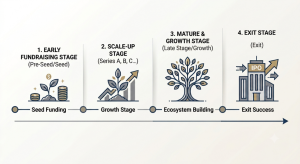
(i) Stage 1 – Early‑Stage Fundraising (Pre‑Seed/Seed):
- Characteristics: Priority is placed on accelerating disbursement by adopting flexible contractual structures and minimizing administrative compliance obligations at the time the transaction occurs.
- Applicable Mechanisms: Implemented through hybrid investment instruments such as Convertible Notes or SAFE agreements. These structures allow the parties to defer valuation at the time capital is received and avoid immediate procedures relating to charter capital adjustment, amendments to the company’s charter, or enterprise registration updates.
(ii) Stage 2 – Scaling Up (Series A, B, C…)
- Characteristics: Marks the transition toward standardizing internal governance structures and establishing a more stringent legal compliance framework.
- Applicable Mechanisms: Conducted through the issuance of new shares to increase charter capital, typically via preferred share classes. This triggers obligations to amend and supplement the company’s Charter, complete capital contribution/share acquisition registration procedures (M&A Approval) for foreign investors, and execute a Shareholders’ Agreement (“SHA”) governing investor protection rights.
(iii) Stage 3 – Maturity & Growth
- Characteristics: Financial structures become multi‑layered and complex, requiring comprehensive compliance review and risk management at the group or ecosystem level.
- Applicable Mechanisms: Introduction of tiered preferred share classes (Series A, B, C) with participation from private equity funds or strategic investors. Transactions may combine new capital injections with secondary purchases from founders or earlier‑round investors. This stage may also trigger obligations to review and submit competition law filings relating to economic concentration.
(iv) Stage 4 – Exit (Successful Divestment)
- Characteristics: Realization of exit rights agreed upon in prior SHAs, with the objective of maximizing returns and distributing capital back to investors.
- Applicable Mechanisms: Implemented through: (x) Initial Public Offering (IPO): Leading to conversion of the company’s legal form, capital restructuring, and full compliance with securities regulations; (y) Contractual buy back commitments: Where the company or founders repurchase investor equity at a pre agreed price or valuation formula under prior investment agreements; or (z) Full sale of the company through an M&A transaction, triggering drag along provisions and liquidation preference mechanisms upon exit.
- Structuring the Transaction
To ensure that a fundraising transaction is successfully executed and that operational risks are minimized, the planning and determination of the transaction structure at the outset is essential. A well‑designed transaction structure not only serves as a legal framework protecting the commercial interests of the parties, but also ensures compatibility with applicable laws, reduces compliance costs, and lays a solid foundation for subsequent fundraising rounds or exit events.
a. Choosing the Appropriate Enterprise Form
In practice in Vietnam, companies, particularly those seeking to raise capital from investors to expand their business, often choose to operate as Joint Stock Companies (JSCs) due to their flexible legal structure and alignment with investment market practices. The advantages of this enterprise form in Series‑based fundraising include:
(i) Diversity of Share Classes: Vietnamese enterprise law allows JSCs to issue multiple classes of shares with flexible layers of rights and preferences, enabling the implementation of complex mechanisms in Series‑based fundraising. In addition to ordinary shares, companies may issue preferred dividend shares, redeemable preferred shares, voting preferred shares, and other classes as provided in the Charter[6]. This legal foundation is critical for recording preferred shares, which investors often require to secure priority rights relating to dividends, liquidation, and capital recovery.
(ii) Liquidity: Beyond the ability to structure layered rights, the JSC model offers superior liquidity and transferability of shares. Share transfers in a JSC are not subject to mandatory pre‑emptive offering to existing members as in an limited liability company[7], except where shareholders voluntarily agree to transfer restrictions in the Shareholders’ Agreement (SHA) or the Charter, or where founding shareholders are restricted from transferring shares during the first three years after incorporation[8]. This mechanism facilitates divestment transactions, shareholder restructuring, and onboarding of new investors. Additionally, because shareholder information is not recorded directly on the Enterprise Registration Certificate, the company avoids administrative procedures for amending business registration each time a share transfer occurs between investors.
(iii) Tiered Governance and Delegated Authority: The governance structure of a JSC clearly allocates authority among the General Meeting of Shareholders, Board of Directors, and Executive Management. This structure ensures transparency while maintaining operational efficiency, avoiding disruptions that would arise if all shareholders had to approve day‑to‑day management decisions. In particular, it allows the company to allocate Board seats to representatives of lead investors in each fundraising round, thereby leveraging their management expertise, networks, and strategic direction..
Given these structural legal advantages, the Joint Stock Company model is optimal for enterprises intending to raise capital across multiple rounds. Accordingly, for companies currently operating as LLCs, restructuring and converting into a JSC is a critical pre‑transaction step to establish a legally suitable framework for receiving investment capital.
b. Transaction document structure
A Series‑based fundraising transaction requires the coordinated use of a comprehensive set of legal documents to ensure enforceability, binding effect, and consistency of investor rights within the same round. Unlike traditional M&A transactions—which are typically tailored to a specific buyer–seller pair—Series‑based fundraising commonly adopts a standardized suite of transaction documents applicable to all participating investors in the issuance. This approach ensures transparency, uniformity in internal governance, and eliminates the risk of conflicting investor rights. However, for certain Lead Investors or investors with unique requirements, the parties may agree on additional bespoke rights through a Side Letter, provided that such rights remain anchored to the standardized framework of the round.
A Series‑based fundraising transaction typically comprises the following core groups of documents:
(i) Investment agreement
Depending on the fundraising structure (issuance of new preferred shares, transfer of existing shares, or use of convertible instruments), the Investment Agreement may take the form of a Share Subscription Agreement, Share Purchase Agreement, or Convertible Loan Agreement (collectively, the “Investment Agreement”). The Investment Agreement governs the disbursement phase and typically includes the following key components:
- Valuation and Capital Allocation Structure: Detailed provisions on pre‑money and post‑money valuation, share price, total number and class of newly issued shares, and the method and schedule of capital disbursement into the company’s account.
- Representations and Warranties: Statements by the Company and Founders regarding the accuracy and legality of financial status, asset ownership, intellectual property rights, compliance with tax and labor laws, and non‑violation of existing contractual obligations.
- Post‑Closing Covenants: Unlike traditional M&A transactions, Series‑based fundraising typically minimizes Conditions Precedent to accelerate disbursement. Instead, outstanding internal legal formalities are shifted into post‑closing covenants, accompanied by remedies such as indemnification or mandatory share buy‑back obligations if the company fails to meet agreed deadlines.
(ii) Shareholders’ Agreement
While the Investment Agreement focuses on implementing the issuance and disbursement of capital, the Shareholders’ Agreement (SHA) serves as the foundational legal instrument governing the management relationship and exit mechanisms throughout the lifecycle of the investment.
- Governance Mechanisms and Reserved Matters: Establishes a list of key corporate decisions (e.g., Charter amendments, capital increases or reductions, incurring debt beyond thresholds, M&A restructuring) that require the written consent of the preferred shareholders or the Board representative designated by the investor.
- Anti‑Dilution Protection: Safeguards the value of the investor’s equity in the event the company issues additional shares in subsequent rounds at a lower price than the current round. Common calculation methods include Full Ratchet and Weighted Average adjustments.
- Transfer Restrictions and Exit Mechanisms: Includes pre‑emptive rights to control the admission of new shareholders, tag‑along rights to protect minority shareholders when founders sell to third parties, and drag‑along rights allowing majority shareholders to compel minority shareholders to sell their shares when a suitable acquirer emerges.
- Liquidation Preference: Specifies the order and priority of distributing remaining assets or proceeds upon dissolution, bankruptcy, or a full exit event (including M&A transactions). Preferred shareholders are typically entitled to receive at least the total amount invested before any residual value is distributed to ordinary shareholders.
(iii) Company Charter
The Charter serves as the binding internal regulatory document applicable to all shareholders, managers, and corporate bodies, and is also the publicly recognized legal instrument by state authorities. In fundraising transactions, the Charter must be amended and supplemented at closing to formalize commercial arrangements and investor rights, particularly those relating to preferred shares, into legally enforceable provisions.
Incorporating SHA provisions into the Charter is critical for enforceability. In disputes or administrative procedures, the Charter is often treated as the primary legal basis for review and resolution. If investor‑protection clauses, such as preferred share rights, special voting thresholds, or reserved matters, are not fully and accurately reflected in the Charter, investors face the risk that internal decisions may be invalidated or that they may be unable to compel compliance under enterprise law.
(iv) Side Letters
A Side Letter is a legal instrument executed bilaterally between (i) the Company, Founders, and specific investors, or (ii) between Lead Investors and other investors in the round.
- Purpose: Records additional bespoke rights or obligations that parties do not wish to disclose publicly or cannot incorporate directly into the Investment Agreement or SHA without disrupting the standardized structure of the round or triggering renegotiation by smaller investors.
- Common Provisions: Board observer rights, priority access to financial reports, tailored covenants on the use of proceeds, or priority participation rights in future fundraising rounds with pre‑agreed commitment limits.
c. Multi‑Investor Investment Mechanisms and the Role of the Lead Investor
In Series‑based fundraising practice, a single issuance round often involves the participation of multiple investors simultaneously. To optimize negotiation efficiency, avoid deadlock in governance, and ensure consistency across transaction documents, the transaction is typically organized around the central role of the Lead Investor.
(i) Legal and Commercial Role of the Lead Investor
The Lead Investor is generally the fund contributing the largest portion of capital in the round and possessing strong expertise in legal due diligence and valuation. From a transaction‑structuring perspective, the Lead Investor plays the following roles:
- Term Sheet Formation: Directly negotiates core commercial terms (valuation, round size, priority rights, reserved matters) with the Founders to establish a standardized term sheet for the entire round.
- Negotiation of Transaction Documents: Leads the drafting and finalization of key transaction documents (Investment Agreement, Shareholders’ Agreement, amended Charter). Follow‑on investors typically join the transaction by accepting the full set of documents negotiated by the Lead Investor, without the ability to renegotiate fundamental terms.
(ii) Representation and Decision‑Making Mechanisms for Investor Groups
To prevent fragmentation of authority and avoid governance bottlenecks after closing, the Shareholders’ Agreement may establish a representation mechanism for the group of preferred shareholders in each round:
- Preferred Shareholder Representative Mechanism: The SHA may designate the Lead Investor (or a representative elected by the majority of preferred shareholders) as the sole point of contact to receive notices, issue approvals, or exercise reserved rights on behalf of the entire investor group.
- Group Voting Thresholds: Instead of requiring unanimous consent from all investors in the round, the transaction documents may adopt a majority‑approval threshold. Decisions meeting this threshold bind all remaining investors in the group, ensuring operational flexibility for the company.
- Key Legal Considerations
Although Vietnamese law provides foundational regulations governing capital raising activities, companies and their advisors must proactively identify potential legal risks in order to select an appropriate transaction structure, minimize the likelihood of disputes, and avoid operational bottlenecks. Key issues requiring attention include:
(i) Compliance with Enterprise Registration Procedures: When issuing additional shares to increase charter capital, the company is required to complete procedures for amending its enterprise registration information with the Business Registration Authority (including recording the number and classes of preferred shares). Given that a fundraising round may involve multiple investors disbursing capital at different times, the company must carefully determine the appropriate closing point, whether to register capital increases in multiple tranches or consolidate them into a single closing, to avoid repeated amendments to enterprise registration, which may result in unnecessary costs and delays.
(ii) Compliance with Foreign Investment and Foreign Exchange Regulations: When receiving capital from foreign investors, the company must review market access conditions, maximum foreign ownership ratios applicable to its business lines, and complete the required capital contribution/share acquisition registration procedures under investment law before executing the transaction. Additionally, if the fundraising round is initially structured as a convertible foreign loan, the company must comply with procedures for registering the foreign loan with the State Bank of Vietnam under foreign exchange regulations. Non‑compliance may result not only in administrative sanctions but also in obstacles to the lawful remittance of investment proceeds or repayment of loan principal and interest abroad.
(iii) Managing Risks Under Competition Law: In later‑stage fundraising rounds involving multinational corporations or large private equity funds, the transaction may trigger economic concentration notification thresholds under competition law. If the combined total assets, total revenue, transaction value, or market share of the participating parties meets statutory thresholds, the parties are required to submit an economic concentration notification upon closing[9].
———
[1] Article 124 Laws on Enterprises No. 59/2020/QH14 promulgated by the National Assembly on 17/6/2020 (“Laws on Enterprises”)
[2] Article 125 Laws on Enterprises
[3] Article 68 Laws on Enterprises
[4] Article 128 Laws on Enterprises
[5] Article 463 Civil code No. 91/2015/QH13 promulgated by the National Assembly on 24/11/2015 (“Civil Code”)
[6] Article 114 Laws on Enterprises
[7] Article 52 Laws on Enterprises
[8] Article 120.3 Laws on Enterprises
[9] Article 13 Decree No. 35/2020/ND‑CP dated 24/3/2020 detailing a number of Articles of the Law on Competition.
———
Disclaimer: This article has been prepared by PTN Legal LLC (‘PTN Legal‘) for the sole purpose of providing reference information to readers. PTN Legal makes no representation or warranty as to the accuracy or completeness of this information. The contents of this article may be changed, amended, or updated without prior notice. PTN Legal assumes no responsibility for any errors or omissions in this article, or for any damage arising from the use of this article in any circumstances. Please visit PTN Legal’s website to view our previous articles here.
Readers who wish to receive articles from PTN Legal by email may register their information here.
This Article was prepared by Chi Hoang, Associate