



In real estate M&A transactions in Vietnam, the acquisition of a portion of an investment project including commercial and service components (“Project“) from a domestic primary developer (“Primary Developer“) by a foreign investor (“Foreign Investor“) can be structured through various legal mechanisms. Depending on the strategic objectives, the parties will negotiate and select the optimal structure based on key factors such as the deal execution timeline, regulatory procedures with state authorities, arising tax obligations, as well as financing solutions to fund the acquisition price.
Under the current legal framework including the Law on Real Estate Business 2023, the Law on Land 2024, the Law on Housing 2023, the Law on Investment 2025, and the implementing guidance, Foreign Investor typically approach transactions through two fundamental structures: (i) direct acquisition of the Project; or (ii) corporate acquisition of the Project-owning entity via share purchase, with various flexible variations.
This article outlines several practical legal structures that we have advised Foreign Investor clients on when acquiring Projects in Vietnam.
- Structure 1 – Direct acquisition of the Project via establishment of a Project Company
Under this structure, the Foreign Investor directly submits an application to acquire the Project from the Primary Developer and establishes a company (“Project Company”) to take over and implement the Project. The Primary Developer and the Project Company will complete land procedures with competent State Authorities (“State Authorities”) and apply for the issuance of a Land Use Rights Certificate (“LURC”) for the land plot under the Project. The required execution steps are outlined below:
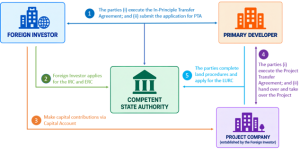
Step 1: The Primary Developer and the Foreign Investor execute an in-principle transfer agreement off the Project (“In-Principle Transfer Agreement”) and jointly submit an application for the transfer of the Project from the Primary Developer to the Foreign Investor to the State Authorities[1]. Upon receiving and reviewing the application, if the parties meet all legal transfer conditions, the State Authorities will issue a decision approving the adjustment of investor, allowing the Primary Developer to transfer the Project to the Foreign Investor (“Project Transfer Approval – PTA”)[2].
Step 2: Based on the issued PTA, the Foreign Investor will submit an application to the State Authorities for an Investment Registration Certificate (“IRC”) pursuant to Article 26.1 of the Law on Investment 2025 and Articles 38 and 39 of Decree 96/2026 regarding the implementation of the Project. Upon issuance of the IRC, the Foreign Investor will submit an application to incorporate the Project Company to obtain an Enterprise Registration Certificate (“ERC”) from the State Authorities[3].
Step 3: The Project Company established under the ERC acts as the project implementation investor[4] and opens a foreign investment capital account (“Capital Account”) to receive equity injections from the Foreign Investor to fund the Project transfer transaction with the Primary Developer [5].
Step 4: The Project Company executes a real estate project partial transfer agreement with the Primary Developer to acquire the Project (“Project Transfer Agreement”), pays the transfer price, and takes over the Project from the Primary Developer. Note that the statutory deadline for the parties to sign the Project Transfer Agreement and hand over the Project alongside all legal files from the Primary Developer to the Project Company is 60 days from the date of the PTA[6].
Step 5: The Primary Developer and the Project Company coordinate to register land use rights in accordance with current land allocation and land lease procedures[7]. Upon completing the execution of the land lease contract with the State Authorities, the Project Company finalizes and submits the dossier for the issuance of the LURC.
- Structure 2 – Pre-established Project Company acquiring the Project
Under this structure, the Foreign Investor will establish the Project Company prior to carrying out the procedures to directly acquire the Project from the Primary Developer, in accordance with the steps summarized below:
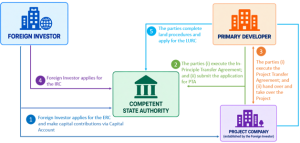
Step 1: The Law on Investment 2025 permits Foreign Investor to carry out procedures to establish the Project Company prior to obtaining an IRC[8]. Upon receiving the ERC, the Project Company proceeds to open a Capital Account to receive equity injections from the Foreign Investor and to pay legitimate costs related to investment preparation activities[9]. Note that one of the statutory conditions to qualify for acquiring the Project is that the charter capital of the Project Company must not be less than 20% of the total investment capital if the Project uses less than 20 hectares of land, or 15% of the total investment capital if the Project uses 20 hectares or more[10].
Step 2: The Project Company and the Primary Developer execute an In-Principle Transfer Agreement and jointly submit an application for the project transfer from the Primary Developer to the Project Company to the State Authorities[11]. Upon receiving and reviewing the application, if the parties meet all legal transfer conditions, the State Authorities will issue a decision approving the adjustment of investor, allowing the Primary Developer to transfer the Project to the Project Company (“PTA”).
Step 3: The Project Company executes the Project Transfer Agreement with the Primary Developer, pays the transfer price, and takes over the Project from the Primary Developer.
Step 4: The Foreign Investor submits an application for the issuance of an IRC in connection with the establishment of the Project Company to execute the Project in accordance with the provisions specified in the PTA.
Step 5: The Primary Developer and the Project Company coordinate to register land use rights in accordance with current land allocation and land lease procedures. Upon completing the execution of the land lease contract with the State Authorities, the Project Company finalizes and submits the dossier for the issuance of the LURC.
- Structure 3 – Establishing a Project Company via M&A to acquire the Project
Under this structure, the Foreign Investor identifies an existing domestic enterprise and acquires 100% of its equity to establish the Project Company. After the Foreign Investor completes the M&A procedures, the Project Company proceeds to execute the project transfer from the Primary Developer according to the steps summarized below:
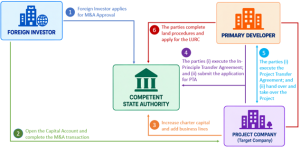
Step 1: Upon selecting a suitable domestic target company, the Foreign Investor completes regulatory procedures with the State Authorities to obtain approval for purchasing 100% of the equity in the target company (“M&A Approval”)[12].
Step 2: Subject to receiving the M&A Approval, the target company opens a Capital Account, and the Foreign Investor completes the acquisition of 100% equity in the target company to establish the Project Company under the Foreign Investor’s control.
Step 3: The Foreign Investor increases the charter capital and adds real estate business lines to the Project Company to meet applicable statutory conditions for acquiring the Project.
Step 4: The Project Company and the Primary Developer execute an In-Principle Transfer Agreement and jointly submit an application for the project transfer from the Primary Developer to the Project Company to the State Authorities[13]. Upon receiving and reviewing the application, if the parties meet all legal transfer conditions, the State Authorities will issue a decision approving the adjustment of investor, allowing the Primary Developer to transfer the Project to the Project Company (“PTA”).
Step 5: The Project Company executes the Project Transfer Agreement with the Primary Developer, pays the transfer price, and takes over the Project from the Primary Developer.
Step 6: The Primary Developer and the Project Company coordinate to register land use rights in accordance with current land allocation and land lease procedures. Upon completing the execution of the land lease contract with the State Authorities, the Project Company finalizes and submits the dossier for the issuance of the LURC.
- Structure 4 – Establishing a Project Company via primary IRC registration to acquire the Project
Under this structure, before acquiring the Project, the Foreign Investor will register a small and straightforward investment project in order to obtain an Investment Registration Certificate (“IRC”) and establish a Project Company. Following its establishment, the Project Company will carry out the procedures for acquiring the Project from the Original Project Owner in accordance with the steps generally illustrated in the diagram below:
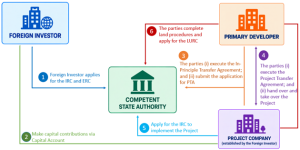
Under this structure, prior to acquiring the Project, the Foreign Investor registers a small, simple investment project to obtain an IRC (“Primary Project”) and establish the Project Company. Once incorporated, the Project Company proceeds to execute the project transfer from the Primary Developer according to the steps summarized below:
Step 1: The Foreign Investor registers to execute the Primary Project, applies for an IRC, and applies for an ERC to incorporate the Project Company to carry out the Primary Project.
Step 2: The Project Company opens a Capital Account to receive equity injections from the Foreign Investor. The Foreign Investor increases the charter capital or adds real estate business lines to the Project Company to meet applicable statutory conditions for acquiring the Project.
Step 3: The Project Company and the Primary Developer execute an In-Principle Transfer Agreement and jointly submit an application for the project transfer from the Primary Developer to the Project Company to the State Authorities[14]. Upon receiving and reviewing the application, if the parties meet all legal transfer conditions, the State Authorities will issue a decision approving the adjustment of investor, allowing the Primary Developer to transfer the Project to the Project Company (“PTA”).
Step 4: The Project Company executes the Project Transfer Agreement with the Primary Developer, pays the transfer price, and takes over the Project from the Primary Developer.
Step 5: Based on the PTA and the Project Transfer Agreement, the Project Company completes procedures to apply for an IRC pursuant to Article 26.1 of the Law on Investment 2025 and Articles 38 and 39 of Decree 96/2026 regarding the implementation of the Project.
Step 6: The Primary Developer and the Project Company coordinate to register land use rights in accordance with current land allocation and land lease procedures. Upon completing the execution of the land lease contract with the State Authorities, the Project Company finalizes and submits the dossier for the issuance of the LURC.
- Structure 5 – Primary Developer in-kind capital contribution of land use rights to establish a Project Company and transferring equity to the Foreign Investor
Under this structure, the Primary Developer makes an in-kind capital contribution using the Land Use Rights (“LUR”) of the Project to incorporate a Project Company. After completing the necessary legal procedures to formally recognize the Project Company as the investor of the Project, the Primary Developer transfers 100% of its equity in the Project Company to the Foreign Investor. The required execution steps are summarized below:
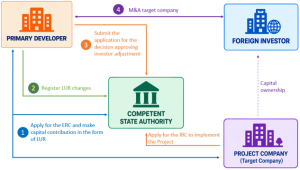
Step 1: The Primary Developer establishes the Project Company and registers capital contribution in the form of LUR with the business registration authority pursuant to the Law on Enterprises 2020. Once the Project Company is incorporated, the Primary Developer signs a capital contribution agreement with the Project Company. This agreement must be notarized or certified in accordance with applicable laws and serves as the legal basis for the parties to carry out investment project adjustment and land registration update procedures[15]. The capital contribution is deemed complete only when the land update/registration of change is registered on the LURC under the name of the Project Company in accordance with regulations.
Step 2: The Primary Developer submits a dossier for the registration of LUR changes to the land registration authority, following the order and procedures specified by the relevant Provincial People’s Committee[16]. Upon receipt and review of the dossier, the land registration authority will endorse the change on the existing LURC or issue a new LURC to the Project Company.
Step 3: The Primary Developer applies for an adjustment of the in-principle investment approval and/or IRC, while simultaneously applying for an IRC for the Project Company to legally record the Project Company as the new investor executing the Project[17].
Step 4: For the purpose of completing the Project M&A transaction, after finalizing the registration of LUR changes and transferring the Project to the Project Company, the Primary Developer transfers its equity in the Project Company to the Foreign Investor. The process at this stage follows standard corporate M&A procedures.
[1] Article 57 Decree No. 96/2026/ND-CP of the Government dated 31 March 2026 detailing and guiding the implementation of a number of articles of the Law on Investment 2025 (“Decree 96/2026”).
[2] Articles 57.6 and 57.8 of Decree 96/2026.
[3] Article 60.7 of Decree 96/2026.
[4] Article 57.12 of Decree 96/2026.
[5] Articles 6.1 and 7.1 of Circular No. 38/2026/TT-NHNN of the State Bank of Vietnam dated 31 March 31 regulating foreign exchange management for foreign direct investment activities in Vietnam (“Circular 38/2026”).
[6] Article 10.6 Decree No. 96/2024/ND-CP of the Government dated 24 July 2024 detailing a number of articles of the Law on Real Estate Business (“Decree 96/2024”).
[7] Article 133.1 of the Law on Land 2024 and Article 14.2 Decree No. 49/2026/ND-CP of the Government dated 31 January 2026 detailing and guiding a number of articles of Resolution No. 254/2025/QH15 of the National Assembly on mechanisms and policies to resolve difficulties and obstacles in the implementation of the Law on Land.
[8] Article 19.2 of the Law on Investment 2025 and Article 72.1 of Decree 96/2026.
[9] Article 5.4 and 7.3 Circular 38/2026.
[10] Article 9.2 of the Law on Real Estate Business 2023.
[11] Article 57 of Decree 96/2026.
[12] Article 21.3 of the Law on Investment 2025 and Articles 74.2, 75.4, and 76 of Decree 96/2026.
[13] Article 57 of Decree 96/2026.
[14] Article 57 of Decree 96/2026.
[15] Article 27.3 of the Law on Land 2024.
[16] Article 133.1 of the Law on Land 2024 and Article 14.2 of Decree 49/2026.
[17] Articles 26.1 and 33.3 of the Law on Investment 2025, and Articles 51 and 61 of Decree 96/2026.
———
Disclaimer: This article has been prepared by PTN Legal LLC (‘PTN Legal‘) for the sole purpose of providing reference information to readers. PTN Legal makes no representation or warranty as to the accuracy or completeness of this information. The contents of this article may be changed, amended, or updated without prior notice. PTN Legal assumes no responsibility for any errors or omissions in this article, or for any damage arising from the use of this article in any circumstances. Please visit PTN Legal’s website to view our previous articles here.
Readers who wish to receive articles from PTN Legal by email may register their information here.
This article was prepared by Phuong Quach, Senior Associate