



According to Decision No. 29/2026/QD-TTg issued by the Prime Minister on 4 June 2026, organizations and enterprises, including foreign direct investment enterprises (“FDI Enterprises“), shall use the organization’s electronic identity (“VNeID“) account when performing online administrative procedures[1]. Traditional login methods on the National Public Service Portal (using digital signatures or old standard accounts) will be gradually transitioned to the VNeID account login method. This transition will be uniformly applied across national critical infrastructure systems, such as the National Public Service Portal, the National Business Registration Portal, and other specialized digital platforms operated by state management agencies. This article will summarize the relevant regulations on organization electronic identification and authentication, while providing compliance notes for FDI Enterprises as well as enterprises that have implemented, are implementing, or plan to implement outbound investment projects.
- Requirements for organization e-identification authentication and procedural steps
According to Decree No. 69/2024/ND-CP issued by the Government on June 25, 2024 (“Decree 69“), agencies and organizations established or registered to operate in Vietnam shall be granted an electronic identity account without distinction as to levels[2]. In which:
- An electronic identity account is a collection of a username, password, or authentication methods used to access and utilize features, utilities, and applications of the electronic identification and authentication system, as well as other connected and shared information systems[3].
- Electronic identification is the activity of registering, comparing, establishing, and associating an electronic identity with an electronic identity subject[4].
Upon completion of electronic identification, the enterprise will be issued an organization identification number established by the electronic identification and authentication system to manage the enterprise’s electronic identity[5]. This identification number is different from the enterprise code/tax identification number created by the National Business Registration Information System, which is issued to the enterprise upon establishment and recorded on the Certificate of Enterprise Registration[6], and is automatically created, sent, and received by the Tax Registration Application System[7]. Through this identification number, the system will simultaneously integrate personal information (including the business owner, legal representative, beneficial owner, etc.), thereby enabling the management of data related to civil status, identity cards, immigration, etc
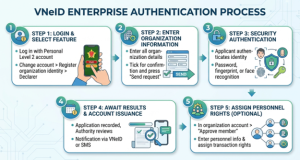
The organization VNeID authentication process is outlined in the following flowchart:
In which:
- Step 1: The legal representative of the enterprise uses their personal level 2 electronic identity account to log into the VNeID application. On the “Change Account” interface, select the “Register Organization Identity” feature, then select “Declarer“.
- Step 2: Enter all required information of the enterprise/organization. Then, check the box “I confirm that the above information is correct and wish to create an electronic identity account for the agency/organization” and press “Send Request“.
- Step 3: The applicant performs security authentication (by entering a password or using fingerprint/face recognition).
- Step 4: The electronic identification and authentication management authority will review the application and notify the legal representative of the result regarding the issuance of the electronic identity account via VNeID or an SMS to their registered phone number.
- Step 5: In case the organization wishes to assign other personnel to perform procedures and transactions, the applicant selects the “Approve Member” section on the organization’s VNeID account. After filling in the employee’s information, the applicant selects “Authorize Online Transactions” to delegate tasks to the personnel.
- Compliance notes for investment activities
Investment activities of foreign investors in Vietnam and outbound investments of Vietnamese investors are tied to numerous procedures regarding business registration, project activity reporting, and foreign exchange transaction registration – most of which have been fully digitized. Accordingly, some compliance notes when conducting investments are as follows:
a. Identity authentication for foreign legal representatives
For FDI Enterprises, the legal representative is typically a foreigner; however, the registration of the organization’s VNeID account must still be mandatorily performed by the legal representative or a properly authorized person using a level 2 VNeID account. Therefore, FDI Enterprises need to proactively obtain electronic identification for their foreign legal representatives to ensure readiness for the enterprise’s e-identification.
According to Decree 69, foreigners aged 6 years or older who have been issued a permanent residence card or a temporary residence card in Vietnam shall be granted a level 1 VNeID account, and a level 2 VNeID account upon request[8]. In cases where a permanent residence card cannot yet be obtained, foreign individuals can still apply for a temporary residence card. Temporary residence cards will be considered for issuance to foreigners temporarily residing in Vietnam who hold visas categorized as LV1, LV2, LS, ĐT1, ĐT2, ĐT3, NN1, NN2, DH, PV1, LĐ1, LĐ2, TT, UĐ1, UĐ2[9] (the ĐT visa codes are issued to foreign investors in Vietnam and representatives of foreign organizations investing in Vietnam). Thus, regarding the entire process, after the Investment Registration Certificate is issued for the project, the foreign individual serving as the legal representative of the FDI Enterprise needs to: 1) apply for a visa; 2) enter the country; 3) declare temporary residence; 4) submit an application for a temporary residence card; and 5) request level 2 VNeID identification.
This process can be time-consuming. To prevent project delays, during the initial phase of establishment, the enterprise may appoint 02 legal representatives (one being a Vietnamese citizen) or appoint a temporary legal representative who is a Vietnamese citizen to authenticate the enterprise’s electronic identity, thereby executing the company’s initial procedures and reporting regimes.
b. Compliance with investment project reporting regimes
Reporting regimes for FDI Enterprises are primarily conducted through the National Public Service Portal, while outbound investment projects are reported via a specialized public service portal, the National Investment Information System (access here), using an electronic account issued to the enterprise. Enterprises need to proactively authenticate their VNeID identity, review the information fields, and monitor the technical requirements of these websites to avoid the risk of delayed reporting and to react promptly if technical errors arise. The specific reporting regimes are summarized below:
For FDI Enterprises issued with an Investment Registration Certificate, the reporting regimes to be executed include:
Report Type | Timeline | Receiving Authority |
Investment supervision and evaluation report | Before July 10 of the reporting year; reporting data calculated from January 1 to the end of 30 June of the reporting year. Before 10 February of the following year; reporting data calculated from 1 January to the end of 31 December of the reporting year. | Provincial-level investment registration authority; Provincial-level People’s Committee. |
Quarterly report [10]
| Before the 10th day of the first month of the quarter following the reporting quarter. | Provincial-level investment registration authority; and Provincial/municipal Statistics Office. |
Annual report[11] | Before 31 March of the year following the reporting year. | Provincial-level investment registration authority; and Provincial/municipal Statistics Office. |
Ad-hoc evaluation report | Upon request by competent state authorities. | |
Supervision and evaluation report prior to investment project adjustment | Prior to submitting the program or project adjustment. | Provincial-level investment registration authority. |
Terminal evaluation report | Prior to the termination of the project. | Provincial-level investment registration authority. |
For enterprises executing outbound investment projects, the reporting regimes to be executed include:
Report Type | Timeline | Receiving Authority |
Notice of outbound investment project execution | Within 60 days from the date the investment project is approved or licensed under the laws of the investment-receiving country. | Ministry of Finance; State Bank of Vietnam; and Vietnamese representative mission in the investment-receiving country. |
Semi-annual periodic report | Before the 20th day of the month following the reporting period. | |
Annual periodic report | Before February 15 of the year following the reporting year. | Ministry of Finance; State Bank of Vietnam; Vietnamese representative mission in the investment-receiving country; and Competent state management authorities. |
Report on the project’s operational status for the fiscal year | Within 06 months from the date of the tax finalization report or a document of equivalent validity. | |
Report on outbound economic organizations investing in a third country or investing in another economic organization in the investment-receiving country | Upon investing in a third country or investing in another economic organization in the investment-receiving country. | |
Ad-hoc report | Upon request by competent state authorities. | |
Report on the implementation status of outbound investment capital transfers[12] | No later than the 5th day of the first month of the quarter immediately following the reporting quarter. | Regional Branch of the State Bank of Vietnam. |
- Execution of foreign exchange transaction registration procedures
For outbound investment activities, after being granted an Outbound Investment Registration Certificate and opening an investment capital account, investors must perform procedures to register foreign exchange transactions related to outbound investment activities with the State Bank of Vietnam[13].
The registration of foreign exchange transactions and registration of changes to foreign exchange transactions are currently also conducted through the specialized public service portal of the State Bank of Vietnam (access here). When performing foreign exchange transaction registration procedures, enterprises must log in using the organization’s VNeID account and register the enterprise’s digital signature template to integrate with this website. In order to avoid missing the capital transfer deadline in outbound investment transactions, immediately after being granted the Outbound Investment Registration Certificate, enterprises need to register their corporate account on the State Bank’s public service portal and install the specialized digital signing software according to the technical guidelines.
————
[1] Article 10.1 of Decision No. 29/2026/QD-TTg issued by the Prime Minister on 4 June 2026.
[2] Article 7.3 of Decree 69.
[3] Article 3.4 of Decree 69.
[4] Article 3.3 of Decree 69.
[5] Article 6.2 of Decree 69.
[6] Article 29.1 of the Law on Enterprises 2020.
[7] Article 8.3 of Decree No. 168/2025/ND-CP issued by the Government on 30 June 2025.
[8] Article 7.2 of Decree 69.
[9] Law No. 118/2025 issued by the National Assembly on 10 December 2025, effective from 1 July 2026.
[10] Article 94.2 of Decree No. 96/2026/ND-CP issued by the Government on 31 March 2026.
[11] Article 94.3 of Decree No. 96/2026/ND-CP issued by the Government on 31 March 2026.
[12] According to Circular No. 12/2016/TT-NHNN issued by the State Bank of Vietnam on 29 June 2016.
[13] Article 10.1 of Circular No. 12/2016/TT-NHNN issued by the State Bank of Vietnam on 29 June 2016.
Disclaimer: This article has been prepared by PTN Legal LLC (‘PTN Legal‘) for the sole purpose of providing reference information to readers. PTN Legal makes no representation or warranty as to the accuracy or completeness of this information. The contents of this article may be changed, amended, or updated without prior notice. PTN Legal assumes no responsibility for any errors or omissions in this article, or for any damage arising from the use of this article in any circumstances. Readers who wish to receive articles from PTN Legal by email may register their information here.
This article was prepared by Hoang Pham, Paralegal.