



On 1 January 2026, Decree No. 337/2025/ND-CP of the Government (“Decree 337”) regulating electronic labor contracts (“ELCs”) officially took effect. Subsequently, on 15 May 2026, the Ministry of Home Affairs issued Circular No. 08/2026/TT-BNV (“Circular 08”) providing detailed guidelines for the implementation of Decree 337. Under these regulations, as of 1 July 2026, the ELC Platform[1] operated by the Ministry of Home Affairs will officially be put into operation, receiving data from information systems serving electronic transactions in the execution and performance of ELCs (“eContract Systems”) of enterprises nationwide.
To assist readers in staying promptly informed of significant changes to the legal framework governing the execution of ELCs, we have summarized the notable provisions pertaining to the application conditions and management mechanisms in this article.
- Definition of ELCs and conditions for participants in ELCs
1.1. Definition of ELCs
In Vietnam, the concept of ELCs is no longer unfamiliar, as the Labor Code 2019 (the “Labor Code”) has recognized the principle that a labor contract may be entered into through electronic means in the form of a data message[2]. Decree 337 has officially codified and clarified the definition as well as the validity of this type of contract. Specifically, an ELC is a labor contract executed and established in the form of a data message in accordance with labor laws and laws on electronic transactions, possessing the same legal validity as a paper-based labor contract[3].
The law merely encourages employers to utilize ELCs as an alternative to paper documents in human resource management and in the settlement of related administrative procedures[4]. Employers have full discretion to choose between executing a paper-based labor contract or an ELC.
1.2. Conditions for participants in ELCs
Currently, Vietnamese law imposes no restrictions on the scale or type of enterprise, nor the job position or title when executing ELCs. Parties participating in the execution and performance of ELCs include employees, employers competent to enter into labor contracts pursuant to Article 18 of the Labor Code, and eContract System providers satisfying all conditions prescribed by law.
a. Employers and employees
Individual employers and employees are required to possess identity documents, including: a citizen identity card, an identity card, an electronic identity, an identity certificate, a level-2 electronic identification account (“VNeID”), or a valid passport; in the case of foreigners, a valid entry visa or documents proving an entry visa exemption are required[5].
For employers that are enterprises, agencies, organizations, cooperatives, or households, the identity documents of their legal representatives and one of the following documents are required: (i) an establishment decision; (ii) a decision regulating functions, duties, powers, and organizational structure; (iii) an enterprise registration certificate; (iv) an investment registration certificate; or (v) a business household registration certificate.
In addition to the above conditions, it is mandatory for employees and employers to possess digital signatures and utilize time-stamping services in accordance with the law on electronic transactions.
b. eContract System providers
eContract System providers are organizations or enterprises possessing an eContract System that satisfies the conditions prescribed in Article 6.1 of Decree 337, which are selected by employers and employees to execute and perform ELCs and to certify ELCs, satisfying conditions including: (i) holding a Trust Service Provision License where the permitted service line is the provision of data message certification services in accordance with the law on electronic transactions; and (ii) possessing solutions and technologies to collect, match, and verify the biometric data (such as fingerprints, facial features, irises, voices, and other biometric factors) of legal representatives and executing individuals when performing identity authentication[6].
- ELC execution process
The ELC execution process is summarized in the diagram below.
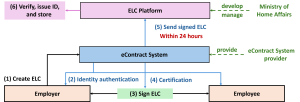
An ELC is generated on the eContract System and must satisfy all conditions prescribed by law, including: identity authentication of the subjects, digital signing with time-stamping, and data message certification by the eContract System provider. Unless otherwise agreed upon by the parties, an ELC takes effect from the time the last party completes a valid digital signing and the data message is certified by the eContract System provider[7]. Within 24 hours from the time of valid contract execution, the eContract System provider is responsible for sending the contract to the ELC Platform to be assigned an identification code (“ID”) in accordance with the regulations of the Ministry of Home Affairs[8]. Upon receipt, the ELC Platform will automatically verify the validity of the submitted information, including the identity authentication information of the employer and the employee, the time-stamps attached to the digital signatures of the executing parties, and the data message certification issued by the eContract System provider[9]. The ELC Platform shall issue a unique 13-character ID for each valid ELC within a maximum period of 24 hours from the time of receiving the valid submitted data [10]. This ID is retained throughout the life cycle of the ELC, even when the contract is amended, supplemented, suspended, or terminated. Related documents, such as contract appendices, notices of suspension, and notices of termination, shall all be linked to this same ID[11]. The system may refuse to issue an ID if errors are detected during the execution process, such as missing identification information, digital signatures, data message certifications, or other circumstances affecting the validity of the ELC[12]. Employers and employees have the right to register for and use access accounts to the ELC Platform to look up, verify, and manage the data of their executed ELCs[13]. Once issued, the ID will be automatically transmitted back to the system of the eContract System provider. Information related to ELCs must be stored for a period of at least 10 years from the date of contract termination[14].
Through the ELC Platform, employers may fulfill their obligations to submit initial labor declarations and periodic reports on labor fluctuation status[15]. This is expected to facilitate the synchronization of labor data between enterprises and state management agencies, while concurrently assisting in the simplification of administrative procedures in the labor sector.
During implementation, any fluctuations relating to labor relations must comply with the principle of data consistency. Current laws prescribe two distinct handling mechanisms depending on the form of the original contract:
- In case the original contract is an ELC: All arising documents such as amending and supplementing appendices, notices of suspension, or notices of termination must be executed via electronic means (unless otherwise agreed) and must mandatorily be linked to the original 13-character ID initially issued[16].
- In case the original contract is in paper form: If the parties wish to amend, supplement, or terminate an existing paper contract through the electronic environment, the original paper contract must mandatorily be converted into an ELC[17] and satisfy the following requirements:
(i) The subjects executing the paper-based labor contract must be authenticated in accordance with the laws on electronic identification and authentication; and
(ii) The converted electronic labor contract must be digitally signed by a competent person of the employer to confirm its accuracy and completeness compared to the original version and to bear legal responsibility for the converted contents. The ELC, upon conversion, must be assigned an ID.
The converted labor contract holds the same validity as the original version upon satisfying all conditions prescribed by the laws on electronic transactions[18].
- Obligations to protect personal data on the ELC Platform
a. Responsibilities and obligations for personal data protection
- Employers:
Employers act as the personal data controllers-cum-processors, having the obligation to clearly notify employees and must obtain their consent prior to collecting and processing data through ELCs. The notification must clearly specify the processing purposes, the types of data collected, and the third parties having the right to access (including the eContract System provider and state agencies)[19].
- eContract System providers:
In the capacity of a personal data processor, the eContract System provider is responsible for complying with security standards during the operation of the software[20].
- Ministry of Home Affairs:
Through the ELC Platform, the Ministry of Home Affairs performs the functions of a management agency and is the authorized data recipient serving state management purposes[21]. Data on the ELC Platform is not publicly accessible. Any agencies or organizations wishing to connect and exploit the data must submit a registration dossier and obtain approval from the Ministry of Home Affairs[22].
b. Mechanism for accessing and exploiting data on the ELC Platform
Data stored on the ELC Platform is not publicly available to the general public and may only be accessed and exploited in cases and within the scope permitted by law. Pursuant to Decree 337 and Circular 08, agencies, organizations, and individuals wishing to connect to or access data from the ELC Platform must submit a registration dossier to the Ministry of Home Affairs, clearly stating the purpose, scope, and requested data groups[23]. Based on such dossier, the Ministry of Home Affairs will review and approve the connection or data access within its competence[24].
Furthermore, agencies, organizations, and individuals are only permitted to access and exploit their own data, or the personal data of others in case the relevant data subject has consented, or when there are other lawful bases in accordance with prevailing laws. The connection is conducted on the principle of non-interference with the contents of the ELCs, no copying of original data, and compliance with legal regulations on data and personal data protection.
This regulation is expected to help ensure that access to ELC data is only granted for legitimate purposes and within permitted limits, while concurrently minimizing risks associated with the unauthorized use and disclosure of information.
- Notes for employers
The digitalization trend is strongly driving the transition from traditional labor contracts to ELCs in order to optimize human resource management within enterprises. Putting the ELC Platform into operation pursuant to Circular 08 is oriented towards creating a uniform standard for the execution, storage, and management of contracts nationwide.
Although prevailing laws do not compel employers to completely eliminate paper-based contracts, once the electronic method is selected, employers are obliged to strictly comply with technical standards and data management procedures. Most notably, they have the obligation to utilize an eContract System provider to connect and synchronize data with the ELC Platform.
To effectively adapt and prevent risks, enterprises that are currently implementing or will implement ELCs should pay special attention to the following issues:
- Assessing the capacity of eContract System providers:
Employers must urgently review the ELC software currently in use to ensure that their current partner is capable of technical integration with the ELC Platform managed by the Ministry of Home Affairs. In case the provider fails to meet the connection standards, employers should proactively seek qualified alternative entities. A list of eContract System providers that have successfully connected to the ELC Platform will be publicly announced on the official portal for employers’ convenient reference.
- Standardizing old ELCs and digitizing paper contracts:
For ELCs that were fully executed prior to the milestone of 1 July 2026, employers need to coordinate with their eContract System provider to re-verify the validity of the digital signatures, time-stamps, and data message certifications before carrying out procedures to apply for the issuance of ID codes from the ELC Platform. In addition, employers may fully utilize the mechanism under Article 6.1.b of Circular 08 to convert existing paper contracts into an electronic format and register to synchronize them onto the system.
- Upgrading mechanisms for storage and personal data protection:
Employers shall bear absolute responsibility for ensuring the safety of the ELC data repository, while concurrently having the obligation to immediately report to competent authorities in case they detect any risks or incidents of information leakage. All activities involving the exploitation and processing of data through the ELC Platform must strictly comply with the prevailing legal framework, especially the Law on Personal Data Protection 2025, the Law on Data 2024, and relevant guiding regulations.
—————
[1] The ELC Platform is a platform developed, operated, and managed by the Ministry of Home Affairs; functioning to centrally manage data on electronic labor contracts and provide shared services to agencies, organizations, enterprises, cooperatives, households, and individuals on a nationwide scale.
[2] Article 14.1 Labor Code.
[3] Article 3.1 Decree 337
[4] Article 4.3 Decree 337.
[5] Article 6.2 Decree 337.
[6] Article 6.3 Decree 337.
[7] Article 7 Decree 337.
[8] Article 6.4 Decree 337.
[9] Article 6.2 Circular 08.
[10] Article 6.2 Circular 08.
[11] Article 4.1 and Article 4.2 Circular 08.
[12] Article 6.5 Circular 08.
[13] Article 19.1.a and Article 20.1.a Decree 337.
[14] Article 18.3 Circular 08.
[15] Article 19.2 Circular 08.
[16] Article 9.1 Decree 337.
[17] Article 9.2.a Decree 337.
[18] Article 8.3 Decree 337.
[19] Article 25 Law on Personal Data Protection 2025.
[20] Article 2.8 and Article 8.9 Law on Personal Data Protection 2025.
[21] Article 11 and Article 17 Decree 337.
[22] Article 13.2 and Article 13.5 Circular 08.
[23] Article 13.2 and Article 18.2 Circular 08.
[24] Article 13.5 Circular 08.
——————-
Disclaimer: This article has been prepared by PTN Legal LLC (‘PTN Legal’) for the sole purpose of providing reference information to readers. PTN Legal makes no representation or warranty as to the accuracy or completeness of this information. The contents of this article may be changed, amended, or updated without prior notice. PTN Legal assumes no responsibility for any errors or omissions in this article, or for any damage arising from the use of this article in any circumstances. Please visit PTN Legal’s website to view our previous articles here.
Readers who wish to receive articles from PTN Legal by email may register their information here.
——————
This article was prepared by Ly Dao, Paralegal