



On 30 September 2026, the Ministry of Finance issued Circular No. 145/2026/TT-BTC providing for the registration, depository, clearing and settlement of securities transactions (“Circular 145”). Circular 145 takes effect from 16 November 2026, replaces Circular No. 119/2020/TT-BTC dated 31 December 2020 of the Ministry of Finance, as amended and supplemented by Circular No. 68/2024/TT-BTC dated 18 September 2024, Circular No. 14/2025/TT-BTC dated 4 April 2025 and Circular No. 18/2025/TT-BTC dated 26 April 2025 (“Circular 119”) in its entirety and abrogates the provisions amending Circular 119 contained in the previous amending circulars[1]. However, Circular 145 does not fix the date of official implementation for the provisions on central counterparty clearing (“CCP”) (Chapter V) and on real-time settlement of listed corporate bonds (Chapter VI).
Circular 145 consolidates a number of provisions that have been applied during 2020–2025. However, in terms of scope, Circular 145 does not govern the clearing and settlement of privately placed corporate bonds or the clearing fund of the derivatives market[2]. Its scope of application has been extended to the Vietnam Securities Clearing Company (“VSC”), the stock exchanges and settlement custodian banks[3].
This article does not revisit the matters addressed previously and focuses on the material changes, most notably the expansion of off-exchange transfers of ownership of securities registered centrally with the Vietnam Securities Depository and Clearing Corporation (“VSDC”) and the detailed legal framework for the CCP operated by VSC, a subsidiary of VSDC.
1. Expansion of the cases of transfer of ownership outside the trading system for securities registered centrally with VSDC
Circular 145 expands the cases in which ownership of securities registered centrally with VSDC may be transferred outside the securities trading system, adding the following permitted cases[4]:
a. the transfer of privately placed shares between professional securities investors during the transfer restriction period[5];
b. the transfer of ownership of securities between a parent company holding 100% of the charter capital and its subsidiary, and the transfer of ownership of securities arising from the division, separation, consolidation, merger, dissolution or termination of operation of entities established offshore[6];
c. the transfer of ownership of shares that have reached the maximum foreign ownership ratio at a negotiated price higher than the ceiling price, which now also applies to economic organizations in which foreign investors hold more than 50% of the charter capital[7]; and
d. the transfer of ownership of securities where an enterprise uses securities registered with VSDC to pay the principal of and interest on privately placed bonds, or to perform the terms and conditions of bonds issued and listed offshore by a public company[8].
In addition, VSDC may consider effecting cases of transfer of ownership of securities other than those stipulated in Article 6.2 of Circular 145, based on the opinion of the State Securities Commission (“SSC”). Circular 145, however, no longer sets out in detail the procedure for obtaining the SSC’s opinion as Circular 119 previously did[9].
2. Other notable changes
a. Blocking of securities: securities blocked at the request of a competent state authority, at the request of an investor or used to secure obligations under secured transactions do not include securities pending settlement of a sell order matched before the time of blocking[10], thereby ensuring settlement certainty for the buyer;
b. Depository at branches: the requirement to report to the SSC upon authorizing a branch to carry out depository activities has been removed; a branch of a securities company may only be authorized to carry out depository activities if it has already been authorized to carry out brokerage activities[11];
c. Securities borrowing and lending: the criteria for securities used as collateral for securities borrowing and lending activities are prescribed by the operational regulations of VSDC and no longer require the approval of the SSC[12];
d. Risk reserve fund: the quarterly appropriation and the use of the risk reserve funds of VSDC and VSC are prescribed in detail; VSC’s risk reserve fund may also be used to ensure cash settlement obligations under the CCP mechanism, with a utilization interest rate of 0.03% and a late payment interest rate of 0.0375% per day[13];
e. Listed corporate bonds: a real-time, transaction-by-transaction settlement method is established, under which bonds are delivered simultaneously with cash settlement on the same trading day in accordance with the delivery-versus-payment principle, and the CCP mechanism does not apply[14]; and
f. Reporting regime: the monthly reports of depository members and clearing members to VSDC and the monthly reports of the settlement bank to the SSC have been removed; periodic reports to the SSC are made in electronic form through a dedicated system[15].
3. VSC to operate the CCP mechanism under a new model
3.1. The model and the participating entities
Circular 119 already contained provisions on the CCP mechanism, under which VSDC would directly perform clearing and settlement, but that mechanism was never implemented. Circular 145 reconstructs this entire legal framework in Chapter V, under which VSC performs clearing and determines settlement obligations as assigned by VSDC. From the effective date of Circular 145 until the date of official implementation of the CCP, however, clearing and settlement continue to be performed under the current mechanism set out in Chapter IV of Circular 145. From the commencement of CCP operation until the application of the real-time settlement method, VSC performs clearing and determines the settlement obligations for listed corporate bond transactions as assigned by VSDC, and VSDC settles the bonds[16].
The CCP mechanism applies to transactions in shares, fund certificates and covered warrants; VSC performs multilateral clearing and determines settlement obligations; VSDC settles the securities; and the settlement bank settles the cash[17]. The clearing and settlement model under the CCP mechanism is illustrated in the diagram below.
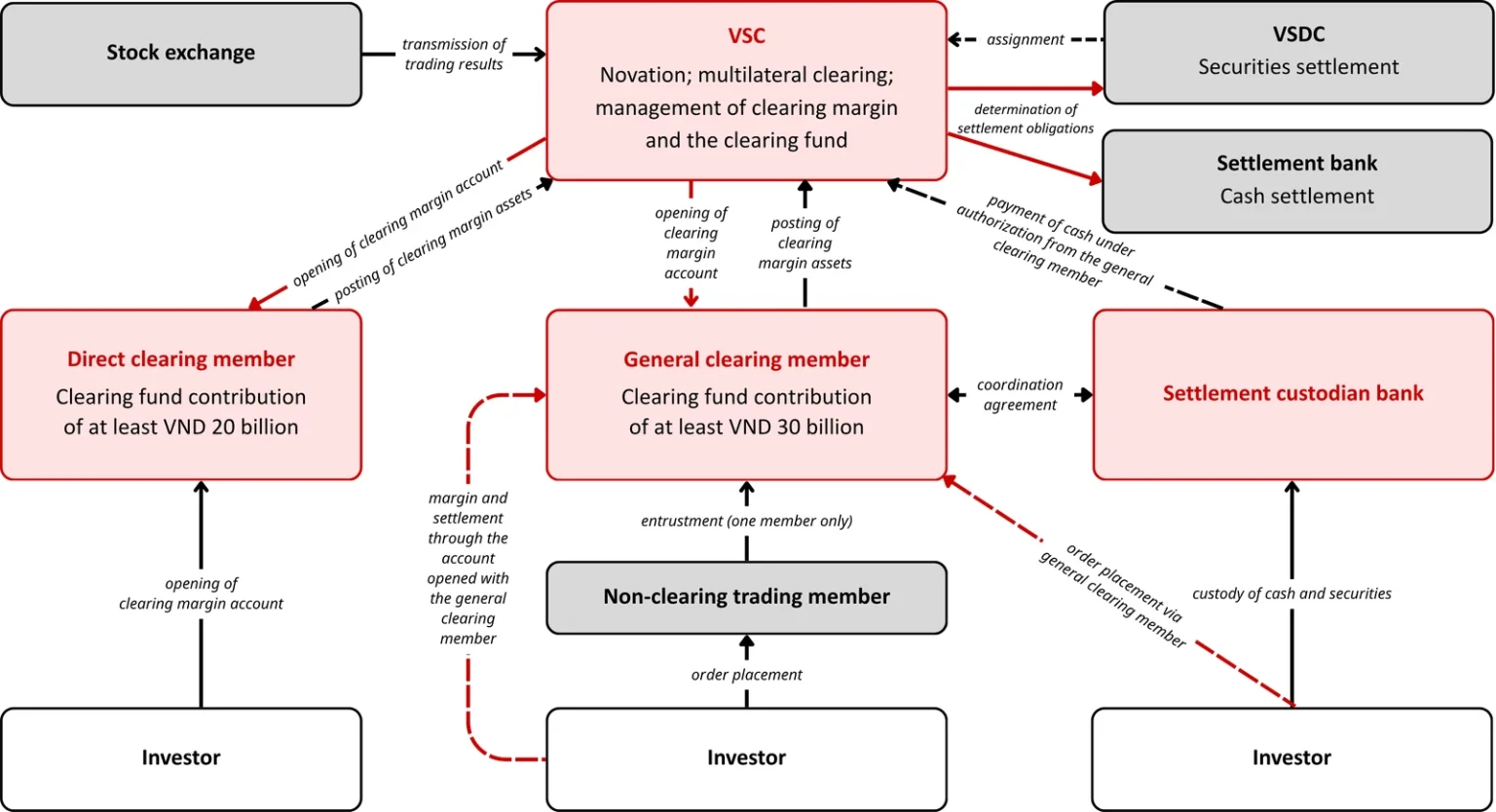
The following points are of note:
a. the clearing margin assets of investors and clearing members consist solely of cash, whereas Circular 119 permitted margin to be posted partly in securities[18];
b. each non-clearing trading member may entrust clearing and settlement to only one general clearing member. On the date of CCP implementation, a trading member whose entrustment agreement has not been recorded by VSC will have its trading activities suspended[19].
3.2. Settlement custodian banks
This is a new model designed to support investors that have opened depository accounts with custodian banks which are not clearing members in carrying out securities settlement transactions. Specifically[20]:
a. a custodian bank that is not a clearing member and that directly provides settlement services to clients must register with VSC and enter into a coordination agreement with the securities company acting as the general clearing member with which the investor intends to place orders; that agreement applies uniformly to all clients of the bank[21];
b. under authorization from the general clearing member, the bank verifies and blocks margin cash and the securities to be sold, and deposits margin and settlement cash into accounts held in the name of VSC[22];
c. the general clearing member bears ultimate responsibility: if the bank fails to settle, the general clearing member must settle in its place and is entitled to receive and sell the purchased securities for which the investor has insufficient cash[23]; and
d. transactions in a depository account at a bank that is neither a clearing member nor a settlement custodian bank will be refused novation and excluded from settlement[24].
4. Clearing margin and risk limits
4.1. Initial margin of investors[25]
a. an investor not falling within the preferential group must post initial margin equal to 100% of the expected value of the buy order (other than margin trading transactions); purchases of covered warrants are always subject to 100% margin[26];
b. the clearing member itself assesses and determines the initial margin level for purchases of shares and fund certificates by foreign institutional investors and by certain domestic financial institutions (including: securities companies (proprietary trading), fund management companies (trading on their own account), securities investment companies, insurance business organizations, commercial banks, foreign bank branches, securities investment funds, voluntary pension funds and supplementary retirement insurance funds licensed to be established and to operate in Vietnam[27]). The mechanism under which full cash is not required upon order placement is thus effectively extended to certain domestic institutions; and
c. an institutional investor referred to above that breaches its margin or settlement obligations must post 100% margin for 7 consecutive trading days; upon a third breach within 30 consecutive trading days, it must post 100% margin for 180 consecutive days. On the date of the breach, the clearing member must report to VSC so that VSC notifies the breach to clearing members and settlement custodian banks for monitoring purposes[28].
4.2. Clearing margin of clearing members
VSC calculates the required clearing margin level on a daily basis for each clearing member in respect of all transactions for which settlement has not been completed. The clearing margin assets of a clearing member may be used only where that member defaults on cash settlement and may not be used to perform settlement obligations arising on a daily basis. A clearing member may authorize a settlement custodian bank to post and supplement margin assets. A clearing member that fails to perform its margin obligations in a timely and complete manner is deemed to have defaulted on the settlement of securities transactions[29].
4.3. Risk limits of clearing members
The difference between the total value of purchase transactions cleared through a clearing member and the total margin cash of investors must not simultaneously exceed: (i) the total amount of the member’s assets convertible into cash; and (ii) twice its owner’s equity less outstanding margin lending balances. The member must perform this calculation and retain records on a daily basis[30]. This constitutes a limit on the capacity of a clearing member to provide trading services that do not require full cash.
5. Clearing fund and handling of settlement default
5.1. Clearing fund
a. The clearing fund is formed solely from cash, with a minimum initial contribution of VND 20 billion for a direct clearing member and VND 30 billion for a general clearing member[31];
b. On a monthly basis, VSC re-evaluates the size of the clearing fund and determines each clearing member’s contribution obligation, and a member must make an ad hoc additional contribution where it is placed under warning, control, special control or early intervention[32]; and
c. Upon the operation of the CCP, the settlement support fund is replaced by the clearing fund. A depository member registering as a clearing member whose settlement support fund contribution balance is at or above the minimum level is deemed to have satisfied its initial contribution obligation; where the balance is lower, the member must pay the difference[33].
5.2. Order of use of the settlement assurance sources
Where a clearing member defaults on cash settlement, VSC uses the available sources in the order set out in the diagram of settlement assurance sources under the CCP mechanism below. Under Circular 145, the use of VSC’s own capital no longer requires the approval of the Ministry of Finance as was required under Circular 119[34]. The use by a clearing member of its own assets to settle in place of an investor is not treated as margin lending[35].

5.3. Changes to compensation
a. The pre-determined compensation levels have been removed: namely 5% of the value of the securities for each day of settlement postponement and 20% of the value of transactions excluded from settlement. Compensation levels are now agreed between the parties, both before and after implementation of the CCP[36];
b. The maximum period of settlement postponement is calculated as 3 trading days[37]; and
c. Under the CCP mechanism, where a transaction short of securities is converted into cash settlement, the selling clearing member must pay the buyer 20% of the value of the securities shortfall[38].
———–
[1] Article 64.2 of Circular 145 abrogates Circular 119 in its entirety, Article 5.2 of Circular No. 68/2024/TT-BTC, Article 1 of Circular No. 14/2025/TT-BTC and Article 1 of Circular No. 18/2025/TT-BTC.
[2] Article 1.2 of Circular 145.
[3] Article 1.4 of Circular 145.
[4] Article 6.2 of Circular 145.
[5] Article 6.2(d) of Circular 145.
[6] Article 6.2(g) of Circular 145.
[7] Article 6.2(q) of Circular 145.
[8] Article 6.2(s) of Circular 145.
[9] Article 6.2(t) of Circular 145; Articles 6.3 and 6.4 of Circular 119.
[10] Article 19.5 of Circular 145.
[11] Articles 9.2 and 9.3 of Circular 145.
[12] Articles 20.2(b) and (c) of Circular 145.
[13] Articles 58 – 60 of Circular 145.
[14] Chapter VI of Circular 145.
[15] Article 61 of Circular 145.
[16] Article 64.5 of Circular 145.
[17] Article 31 of Circular 145.
[18] Article 31.4 of Circular 145.
[19] Article 32.3 of Circular 145.
[20] Article 2.11 and Article 33 of Circular 145.
[21] Article 33.2 of Circular 145.
[22] Articles 33.4, 33.7 and 33.8 of Circular 145.
[23] Articles 31.8 and 33.9 of Circular 145.
[24] Article 46.2(g) of Circular 145.
[25] Article 35 of Circular 145.
[26] Article 35.3 of Circular 145.
[27] Article 35.2(b) of Circular 145.
[28] Article 35.5 of Circular 145.
[29] Article 37 of Circular 145.
[30] Articles 32.8 and 32.9 of Circular 145.
[31] Articles 56.1 and 56.2 of Circular 145.
[32] Articles 56.3 and 56.4 of Circular 145.
[33] Articles 55.1 and 55.2 of Circular 145.
[34] Article 43.4(d) of Circular 145; Article 35.2(dd) of Circular 119.
[35] Article 44.4 of Circular 145.
[36] Articles 28, 29.2, 43.6(d) and 46.3 of Circular 145.
[37] Articles 28.2 and 43.6(b) of Circular 145.
[38] Article 43.8 of Circular 145.
——–
Disclaimer: This article has been prepared by PTN Legal LLC (‘PTN Legal‘) for the sole purpose of providing reference information to readers. PTN Legal makes no representation or warranty as to the accuracy or completeness of this information. The contents of this article may be changed, amended, or updated without prior notice. PTN Legal assumes no responsibility for any errors or omissions in this article, or for any damage arising from the use of this article in any circumstances. Please visit PTN Legal’s website to view our previous articles here.
Readers who wish to receive articles from PTN Legal by email may register their information here.
This article was prepared by Ly Dao, Paralegal