



On 30 June 2026, the State Bank of Vietnam (“SBV”) issued Circular No. 34/2026/TT-NHNN guiding foreign exchange management for outward investment activities (“Circular 34”), which officially takes effect from 31 July 2026 and entirely replaces Circular No. 12/2016/TT-NHNN (“Circular 12”). Developed on the basis of the new Law on Investment 2025 and the Government’s Decree No. 103/2026/ND-CP dated 31 March 2026 on outward investment (“Decree 103”), the new circular establishes an updated legal framework aimed at refining the mechanism for controlling and supervising capital flows serving outward investment activities. Circular 34 focuses on digitalizing the registration process, permitting the flexible use of both Vietnamese Dong and foreign currencies for pre-investment accounts, and clearly delineating the management mechanism for each group of projects that are or are not subject to the issuance of an Outward Investment Registration Certificate (“OIRC”). This article analyzes the key changes above to assist investors in proactively complying with the regulations.
1. Foreign exchange transaction registration procedures by project type
1.1. Procedures for projects subject to the issuance of an OIRC
For this group of projects, the authority to certify the registration and change registration of foreign exchange transactions is assigned to the SBV regional branch where the investor, being an organization (other than a credit institution), is headquartered or where the investor, being an individual, has registered permanent residence; projects of investors that are credit institutions fall under the authority of the SBV[1]. The dossier for the initial registration of foreign exchange transactions comprises: (a) a registration form using the prescribed template; (b) the document approving or licensing the investment issued by the competent authority of the host country, together with citations of the host country’s regulations applicable to the form of investment of the project (or documents evidencing the right to conduct investment activities in the host country in the cases prescribed by law); and (c) a written confirmation from the authorized bank regarding the pre-investment account, the investment capital account and the status of foreign exchange transactions[2]. Within 07 (seven) working days from the date of receipt of a complete and valid dossier, the competent authority shall issue a written certification of the foreign exchange transaction registration (“SBV Approval”) or a written refusal stating the reasons[3].
The foreign exchange transaction registration procedure has now been made available on the National Public Service Portal for end-to-end digitalization; in addition to submission in person or by post under Article 20.1 of Circular 34, in practice certain SBV regional branches give priority to online submissions. Accordingly, investors should proactively familiarize themselves in advance with the technical steps for authenticating the enterprise’s electronic identification before carrying out the procedure. We have also published an article providing guidance on this matter (read the article here).
1.2. Procedures for projects not subject to the issuance of an OIRC
a. Projects under Article 18.1 of Decree 103
This group comprises investment projects with an investment capital of less than 7 billion Vietnamese dong that do not fall within conditional business lines for outward investment. The authority to issue the SBV Approval for this group of projects rests with the SBV regional branch. The dossier for the initial registration of foreign exchange transactions for this group of projects comprises[4]:
(i) The initial foreign exchange transaction registration form using the prescribed template;
(ii) A written confirmation from the tax authority of the investor’s fulfillment of its tax obligations (dated no more than 03 (three) months before the dossier submission date);
(iii) Documents on the legal status of the investor;
(iv) The document approving or licensing the investment issued by the competent authority of the host country, together with citations of the host country’s regulations applicable to the form of investment of the project;
(v) Documents evidencing the investor’s participation in the management of the overseas economic organization where the investor’s ownership ratio of contributed capital or shares is less than 50%;
(vi) A written account confirmation from the authorized bank specifying the automatically generated filing code from the National Investment Information System, and documents evidencing legal status; and
(vii) Documents identifying the project implementation location (if applicable).
The processing time for dossiers of this group of projects is 30 working days from the date the authority receives a complete and valid dossier[5].
b. Projects under Article 18.2, Article 18.3 and Article 18.4 of Decree 103
This group comprises special projects associated with national defense and security (Article 18.2); projects of state-owned economic groups and corporations listed in Appendix I to Decree No. 366/2025/ND-CP of the Government dated 31 December 2025 on management and investment of state capital in enterprises (Article 18.3); and projects not subject to reporting to the Prime Minister for approval that are carried out by other economic organizations simultaneously satisfying the conditions on large enterprise scale, use of their own foreign currency without borrowed capital, profitable business operations in the 2 consecutive years preceding the year of investment, and having at least 2 outward investment projects with profits repatriated to Vietnam (Article 18.4). The authority to certify the registration and change registration of foreign exchange transactions for these special projects rests with the SBV (Foreign Exchange Management Department).
In addition to the basic documents prescribed in Article 15.1 (and Article 15.2 where documents identifying the project location are required) of Circular 34 as set out in Section 1.2(a) above, the initial registration dossier for this group of projects must include the following additional documents:
(i) For projects associated with national defense and security (Article 18.2): an agreement between the two Governments or an agreement between agencies of the two countries approved by the Government[6];
(ii) For state-owned economic groups and corporations (Article 18.3): documents relating to the authority to decide on outward investment[7]; and
(iii) For other large economic organizations (Article 18.4): documents evidencing that the enterprise is of large scale; a written commitment to take responsibility before the law for using its own foreign currency and not using borrowed capital for outward investment; a written confirmation from the authorized bank of the foreign currency or Vietnamese Dong balance in the investor’s account; profitable consolidated financial statements for the 02 (two) consecutive years preceding the year of investment; and documents evidencing at least 02 (two) outward investment projects with profits repatriated to Vietnam[8].
The processing time is 45 working days from the date of receipt of a complete and valid dossier[9].
1.3. Validity of the SBV Approval
The validity of the SBV Approval and the amended SBV Approval is now regulated in greater detail than under the general provisions previously set out in Circular 12, with a view to strengthening the supervision of outward investment capital flows and limiting situations where projects have been certified for registration but are not implemented in practice. The circumstances in which the foreign exchange certification currently ceases to be valid are summarized in the following diagram:
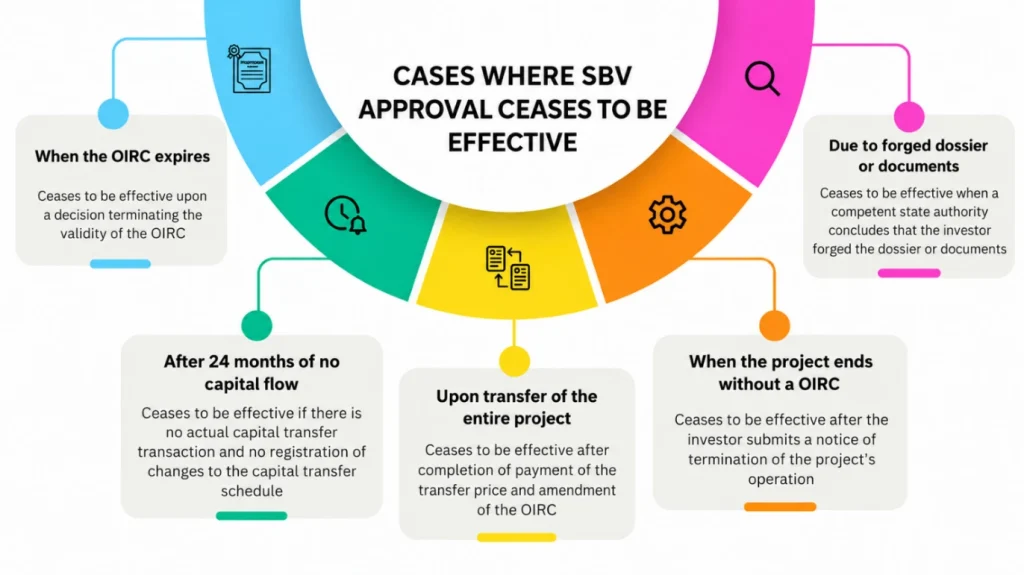
a. Termination of validity following the OIRC: For projects subject to the issuance of an OIRC, the SBV Approval or the amended SBV Approval shall automatically cease to be valid upon the issuance of a decision terminating the validity of the OIRC[10].
b. Termination of validity due to failure to transfer capital within 24 months: If, upon the expiry of 24 months from the capital transfer schedule for cash investment capital abroad certified by the authority in the SBV Approval, the investor has not made any actual cash capital transfer and has not carried out the procedure for registering a change to the capital transfer schedule as prescribed, the issued SBV Approval shall automatically cease to be valid. Within such 24-month period, if the investor has not yet transferred capital but wishes to change the capital transfer timeline from the certified schedule, the investor must carry out the procedure for registering changes to foreign exchange transactions with the SBV or the SBV regional branch[11].
c. Termination of validity upon transfer of the entire project: Where the entire outward investment project is transferred to a domestic investor, upon completion of payment for the transfer, the transferor must notify in writing the foreign exchange authority that most recently granted the certification. Once the transferee has completed the adjustment of the OIRC (for projects with an OIRC) or has been granted an SBV Approval (for projects without an OIRC), the initial/amended SBV Approval of the transferor shall automatically cease to be valid[12].
d. Termination of validity upon termination of a project without an OIRC: Where an investment project not subject to the issuance of an OIRC terminates its operations, within 60 (sixty) days from the date of completing the liquidation of the overseas project and repatriating the liquidation proceeds (if any), the investor must send a notice of termination of investment activities using the prescribed template (including a commitment that the liquidation has been completed and the liquidation proceeds have been repatriated) to the foreign exchange authority that most recently certified the registration and to the authorized bank where the investment capital account is opened. From the time the investor sends this notice, the issued initial and/or amended SBV Approval shall automatically cease to be valid[13].
e. Termination of validity due to forged dossiers or documents: Upon a conclusion by a competent state authority that the investor has forged dossiers or documents for the registration or change registration of foreign exchange transactions, the competent foreign exchange registration certifying authority shall issue an official document to the investor and the authorized bank where the investor opened the investment capital account to terminate the validity of the issued SBV Approval, clearly stating the reasons for such termination[14].
2. Opening and use of pre-investment accounts
Circular 34 has expanded the scope of regulation on the currency of pre-investment accounts. Instead of being permitted to open such accounts only in foreign currency as under Circular 12, investors may now open accounts in foreign currency and/or Vietnamese Dong (the latter applies only to remittances to countries or territories that have agreements or treaties with Vietnam permitting the use of Vietnamese Dong in payment and remittance transactions) at the same 01 authorized bank to pay lawful expenses for the formation of the project. Under the account management principle, investors must open a separate pre-investment account for each project. For outward investment projects involving multiple investors, each investor must open a separate pre-investment account, but all such accounts must be opened at the same 01 authorized bank[15].
Where an investor wishes to change the bank at which its pre-investment account is opened, the investor must carry out a transition procedure. Specifically, the investor shall open a new pre-investment account at another bank. Within 10 (ten) working days from the date of opening the new account, the investor must transfer the entire balance from the old account to the new account and close the old pre-investment account. The investor must provide the new bank with a written confirmation from the old bank of the closure of the account and the status of foreign exchange transactions on the old account as at the closing date[16]. Except for the receipt of the transferred balance, the new pre-investment account may only be used for other receipt and payment transactions after the investor has completed all procedures for closing the old account. Once the project has been granted an OIRC or an automatically generated filing code, the investor must use this pre-investment account as the investment capital account. Where the investor wishes to open an additional investment capital account in another currency, such account must be opened at the same bank where the most recent pre-investment account was opened, and the investor must carry out the initial registration of foreign exchange transactions[17].
3. Remittances abroad prior to investment
All remittances abroad prior to investment must be made through the pre-investment account in foreign currency and/or Vietnamese Dong opened at the same 01 authorized bank. Regarding the limit, unless otherwise provided by the Government, the total amount remitted abroad prior to investment (including the amounts of all investors for projects involving multiple investors) must not exceed 5% of the total outward investment capital and must not exceed USD 300,000, and shall be counted towards the total outward investment capital[18]. In addition, the total amount remitted prior to investment plus the cash investment capital registered by each investor for transfer after the project is licensed must not exceed the total cash investment capital recorded in the OIRC or the initial SBV Approval[19].
To ensure strict control over capital transfers abroad, Circular 34 sets out the investor’s obligation to repatriate foreign currency where the project cannot be established. If the overseas investment project cannot be established or the issuance of the relevant approvals (such as the OIRC or the initial SBV Approval) is refused, the investor must repatriate the full amount remitted abroad that has not been fully used, or any amount refunded by the foreign partner. Such amounts must be repatriated to Vietnam through the pre-investment account within 60 working days from the date the investor receives the written refusal from the competent authority of Vietnam or of the host country[20]. After transferring the entire balance of the pre-investment account to its payment account, the investor must close the pre-investment account.
4. Repatriation of capital from abroad
Amounts derived from overseas investment projects must be repatriated to Vietnam through the investment capital account opened by the investor at the authorized bank[21]. Where profits and other lawful income are not repatriated to Vietnam within 12 months from the date of profit distribution (which period may be extended by no more than 12 months), the investor must give prior written notice to the Ministry of Finance and to the SBV or the SBV regional branch that most recently certified the foreign exchange transaction registration[22].
Where accumulated profits from overseas investment activities are used for reinvestment, the investor shall carry out separate administrative procedures depending on the specific purpose of use:
a. Use of profits to continue capital contribution (applicable to projects whose registered capital has not been fully contributed): The investor must carry out the procedure for registering changes to foreign exchange transactions. The dossier must be submitted within 15 days from the date of issuance of the amended OIRC (for projects subject to the issuance of an OIRC), or within 05 days from the date of completing the update of the changed information on the National Investment Information System (for projects not subject to the issuance of an OIRC)[23].
b. Use of profits to increase investment capital (applicable where capital is increased beyond the initially registered amount): The investor is not required to register changes but shall send a written notice to the foreign exchange authority that most recently certified the registration. The notice must be sent within 15 days from the date of issuance of the amended OIRC (for projects with an OIRC) or from the date of completing the update of the changed data on the National Investment Information System (for projects without an OIRC)[24].
c. Use of profits to implement a new investment project: Where the investor uses overseas profits to invest in another independent overseas project, the investor must apply for an SBV Approval for such new project[25].
d. Use of profits to settle obligations arising abroad: For obligation swap transactions with foreign partners operating in Vietnam, the investor must submit a written notice enclosing supporting documents to the foreign exchange authority that most recently granted the certification within 30 working days from the date the competent authority issues or adjusts the OIRC[26].
5. Statistical reporting regime for investors
Circular 34 specifically sets out investors’ periodic statistical reporting obligations to support the monitoring and supervision of outward investment capital flows. Accordingly, on a quarterly basis, no later than the 5th day of the first month of the quarter following the reporting quarter, investors must submit a report on outward investment capital transfers using the template in Appendix 18 and a report on the repatriation of capital, profits and other lawful income to Vietnam using the template in Appendix 19 issued together with Circular 34 to the SBV or the SBV regional branch that most recently certified the foreign exchange transaction registration. The exchange rate between other currencies and the US Dollar for statistical reporting purposes is the foreign currency accounting exchange rate announced by the Ministry of Finance (State Treasury) applicable at the time of reporting[27].
The method of submitting reports depends on the authority that certified the project’s foreign exchange transaction registration. For projects under the authority of the SBV regional branch, investors shall submit hard-copy reports bearing the investor’s signature and the seal of the investor’s legal representative (where the investor is an organization). For projects under the authority of the SBV, investors shall submit reports electronically to the SBV (Foreign Exchange Management Department) at the email address [email protected], including a scanned copy of the signed and sealed report in PDF format and the report data file using the template in Excel format[28].
The above reporting method applies until the SBV’s web portal on foreign exchange management for outward investment activities is completed. Once this web portal has been completed and put into operation, investors shall submit the reports in Appendix 18 and Appendix 19 directly on the portal. In addition to periodic reports, investors must also submit ad hoc reports at the request of the SBV and the SBV regional branch, and are responsible for the accuracy of the reported data[29].
In general, Circular 34 has established a foreign exchange management mechanism for outward investment activities that is more transparent, stringent and better aligned with practice, through the digitalization of registration procedures, the clear delineation of authority and dossier requirements for each group of projects, the specific regulation of the circumstances in which the SBV Approval ceases to be valid, and the expansion of the currencies that may be used for pre-investment accounts. At the same time, investors’ obligations regarding procedural timelines, capital transfers, the repatriation of profits and other lawful income to Vietnam, and notifications to the foreign exchange authority are regulated more strictly. Accordingly, non-compliance with these regulations may result in the SBV Approval automatically ceasing to be valid or give rise to the investor’s legal liability in accordance with the law. Therefore, investors, particularly those implementing or planning to implement outward investment projects, should review the legal status of their projects, the certified capital transfer schedules and the status of the relevant accounts in order to promptly carry out any necessary adjustment procedures and ensure full compliance with Circular 34 from its effective date.
———–
[1] Article 12.1(a) and Article 12.2(a) of Circular 34.
[2] Article 14 of Circular 34.
[3] Article 21.2 of Circular 34.
[4] Article 15.1 and Article 15.2 of Circular 34.
[5] Article 21.2 of Circular 34.
[6] Article 15.3(c) of Circular 34.
[7] Article 15.4(c) of Circular 34.
[8] Article 15.5 of Circular 34.
[9] Article 22.3 of Circular 34.
[10] Article 23.1 of Circular 34.
[11] Article 23.2 of Circular 34.
[12] Article 23.3 of Circular 34.
[13] Article 23.4 of Circular 34.
[14] Article 23.5 of Circular 34.
[15] Article 4.1, Article 6.1 and Article 6.2 of Circular 34.
[16] Article 6.3 of Circular 34.
[17] Article 6.7 of Circular 34.
[18] Article 6.1 and Article 6.4 of Circular 34 and Article 32.5 of Decree 103.
[19] Article 6.5 of Circular 34.
[20] Article 6.6 of Circular 34.
[21] Article 24.2 of Circular 34.
[22] Article 24.3 of Circular 34 and Article 34.1 and Article 34.3 of Decree 103.
[23] Article 25.1 of Circular 34.
[24] Article 25.2 of Circular 34.
[25] Article 25.3 of Circular 34.
[26] Article 25.4 of Circular 34 and Article 34.2 of Decree 103.
[27] Article 33.1 and Article 5.5 of Circular 34.
[28] Article 33.2 of Circular 34.
[29] Article 31, Article 35 and Article 27.9 of Circular 34.
———
Disclaimer: This article has been prepared by PTN Legal LLC (“PTN Legal”) for the sole purpose of providing reference information to readers. PTN Legal makes no representation or warranty as to the accuracy or completeness of this information. The contents of this article may be changed, amended, or updated without prior notice. PTN Legal assumes no responsibility for any errors or omissions in this article, or for any damage arising from the use of this article in any circumstances. Please visit PTN Legal’s website to view our previous articles here.
Readers who wish to receive articles from PTN Legal by email may register their information here.
This Article was prepared by Thao Vu, Paralegal