



On 25 September 2026, the Ministry of Finance issued Circular No. 138/2026/TT-BTC guiding certain provisions of Decree No. 200/2026/ND-CP on the private placement and trading of corporate bonds in the domestic market and the offering of corporate bonds to the international market (“Circular 138”). Circular 138 takes effect from 1 October 2026 and fully replaces Circular No. 30/2023/TT-BTC dated 17 May 2023 guiding the registration, depository, exercise of rights, transfer of ownership, transaction settlement and organization of the trading market for privately placed corporate bonds in the domestic market (“Circular 30”) and Circular No. 76/2024/TT-BTC dated 6 November 2024 guiding the information disclosure and reporting regime for private placement and trading of corporate bonds in the domestic market and offering of corporate bonds to the international market (“Circular 76”).
The issuance of Circular 138 completes the system of implementing guidance following the Government’s issuance of Decree No. 200/2026/ND-CP dated 5 June 2026 (“Decree 200”), which replaced the previous regulatory framework on corporate bond offerings and trading. Against this background, this article highlights and analyzes several notable changes under Circular 138 compared with the previous regulations on registration, depository, transfer of ownership, trading and information disclosure for privately placed corporate bonds, and identifies certain matters that Issuers should note in practice.
- Changes to the information disclosure mechanism for payment of bond principal and interest
One notable change under Circular 138 is the adjustment to the manner in which information disclosure obligations relating to payment of bond principal and interest are performed. Accordingly, the Issuer’s information disclosure obligations are illustrated below:
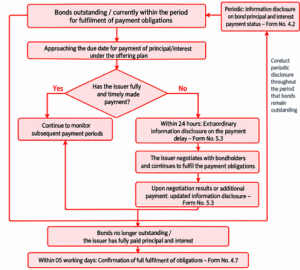
Previously, under Circular 76, Form No. 3.2 of Appendix III covered periodic information disclosure on payment status, completion of payment upon bond maturity, late payment, and updates on payment results after a delay. Circular 138 separates these circumstances into distinct disclosure forms, as follows:
- Form No. 4.2 of Appendix IV: used for periodic disclosure on principal and interest payment status[1];
- Form No. 5.3 of Appendix V: used specifically where the Issuer is late in paying principal or interest under the issuance plan, for the results of negotiations with Bondholders, and for additional payment or completion of payment after a period of delay; these events constitute extraordinary disclosure events and must be disclosed by the Issuer within 24 hours after the event occurs[2];
- Form No. 4.7 of Appendix IV: used to confirm that the Issuer has fully performed its obligations to Bondholders, including full payment of principal and interest, within 05 working days from the date on which the bonds are no longer outstanding[3].
Accordingly, Circular 138 is not the first regulation to impose an extraordinary information disclosure obligation when an Issuer is late in payment; rather, it separates this content from Form No. 3.2 of Appendix III Circular 76, which was used for multiple payment-related circumstances, and establishes Form No. 5.3 of Appendix V specifically for late payment and subsequent updates on the payment status.
In addition, to further specify and ensure consistent implementation of the new information disclosure obligation under Decree 200 for bonds bearing a floating interest rate or a combination of fixed and floating interest rates, Circular 138 prescribes a separate Form No. 4.6 of Appendix IV. Accordingly, the Issuer must disclose the actual interest rate applicable to the relevant interest calculation period, using this form, to Bondholders and HNX no later than 01 working day before the interest payment date[4]. From an operational perspective, this provision requires the Issuer to proactively determine the interest rate and complete the relevant disclosure before the interest payment date; where relevant service providers are involved, the Issuer should coordinate with them to ensure this deadline is met[5].
- Specifying the time limits for adjustment of bond information at VSDC and HNX
Previously, Circular 30 provided for the adjustment of bond information as follows:
- For information registered with the Vietnam Securities Depository and Clearing Corporation (“VSDC”): the Issuer was responsible for adjusting bond information registered with VSDC when changes occurred, but Circular 30 did not prescribe a specific time limit for making such adjustment[6].
- For trading registration information at the Hanoi Stock Exchange (“HNX”): Circular 30 prescribed a 10-day time limit where information on the Issuer changed due to consolidation, merger or a change to the Enterprise Registration Certificate. Where the terms and conditions of the bonds changed, the Issuer was required to change the information at HNX in accordance with the Rules on Trading of Privately Placed Corporate Bonds of the Vietnam Stock Exchange, but Circular 30 did not directly prescribe a specific time limit for such change[7].
Circular 138 introduces specific time limits for adjustment of bond information at VSDC and HNX and clarifies the sequence for reducing the number of bonds between the two systems. Specifically:
- For information registered with VSDC: the Issuer must make the adjustment within 10 days from the date of the change and no later than 05 working days before the bond maturity date. Where a change to the terms and conditions of the bonds results in a reduction in the number of registered bonds, the reduction must be made before or concurrently with the update to the terms and conditions[8].
- For trading registration information at HNX: where the terms and conditions of the bonds change, the Issuer must submit a request to adjust the bond trading registration information to HNX within 10 days from the date of the change. In the case of a change to the bond tenor, the adjustment request must be submitted no later than 05 working days before the bond maturity date under the original issuance plan disclosed to investors; in the event of non-compliance, the Issuer is responsible for any loss caused to Bondholders[9].
In addition, Circular 138 clarifies the sequence for reducing the number of bonds between VSDC and HNX. After the Issuer completes the procedures for reducing the number of registered bonds, VSDC makes the corresponding reduction and simultaneously sends a notice to HNX; once the Issuer has completed the reduction at VSDC, HNX makes the corresponding reduction in the number of bonds registered for trading[10].
- Clarifying the cases of bond deregistration and expanding the cases of transfer of bond ownership outside the trading system
Bond deregistration: Circular 138 further specifies the cases in which VSDC deregisters bonds. While Circular 30 essentially linked deregistration at VSDC to cancellation of trading registration, Circular 138 directly lists the grounds for deregistration, including[11]:
- Bonds mature or are fully repurchased, exchanged or converted;
- The Issuer’s license or equivalent legal document is revoked;
- VSDC discovers that the Issuer has falsified the bond registration dossier, or receives a request from HNX after HNX discovers that the Issuer has falsified the trading registration dossier;
- The Issuer ceases to exist due to dissolution, bankruptcy or division; and
- The bonds are cancelled pursuant to a judgment or decision of a court, arbitration tribunal or competent authority.
Transfer of bond ownership: Circular 138 expands and further specifies the cases of transfer of ownership outside the trading system. In addition to the cases already recognized under Circular 30, such as gifts, inheritance, corporate reorganization, enforcement against collateral or transfers pursuant to judgments or decisions of competent authorities, Circular 138 adds or further specifies the following cases[12]:
- Transfer of ownership to address settlement failures in securities transactions;
- Transfer of ownership in connection with discretionary portfolio management, including transfers of bonds between entrusting investors and fund management companies, or between fund management companies, in cases involving acceptance of assets under management, change or termination of a portfolio management agreement, dissolution, bankruptcy or cessation of operations of a fund management company; and
- Other cases of transfer of ownership, including transfer of ownership of bonds that are valuable papers in the money market at the request of the State Bank of Vietnam and other cases considered and implemented by VSDC based on the opinion of the State Securities Commission of Vietnam.
The more specific enumeration of these cases provides a clearer operational basis for VSDC and depository members when processing ownership changes outside the system. However, any transfer must still comply with the investor eligibility requirements under Decree 200. For bonds deposited at VSDC, when ownership is transferred outside the trading system, the depository member is responsible for verifying the transferee’s status as a professional securities investor before submitting the transfer request, except for transfers pursuant to an effective court judgment or decision, an arbitral award or inheritance.
- Transitional provisions and certain practical considerations for Issuers
For an Issuer that changed the terms and conditions of bonds under Decree 200, resulting in a reduction in the number of registered bonds, but had not made the corresponding reduction at VSDC before Circular 138 took effect, the Issuer must complete the adjustment within 30 days from 1 October 2026[13].
In light of the changes under Circular 138, Issuers with outstanding bonds should review and update at least the following:
- Key deadlines to note: the time limits for adjusting registration information at VSDC/HNX, disclosing the actual interest rate before an interest payment date, making extraordinary information disclosure in the event of late payment, and confirming completion of obligations when the bonds are no longer outstanding;
- Information disclosure forms: switch to the forms issued under Circular 138 and Decree 200;
- Dossiers and procedures for amending the terms and conditions of bonds: when contemplating an amendment to the terms and conditions of bonds, the Issuer should concurrently determine whether the amendment affects the number of registered bonds, the bond tenor or the trading registration information, and accordingly prepare the relevant dossier and make the corresponding updates at VSDC/HNX within the applicable time limits; and
- Transaction documents and service agreements: review provisions that refer to Circular 30 or Circular 76, or describe registration, depository, payment and information disclosure procedures under the previous framework, and update them to align with Decree 200 and Circular 138.
Overall, Circular 138 does not overhaul the operating structure of the privately placed corporate bond market. Rather, it primarily consolidates the two groups of rules previously contained in Circular 30 and Circular 76, while specifying time limits, procedures for handling post-issuance changes, and information disclosure obligations in circumstances directly affecting Bondholders’ rights. For Issuers, updating internal procedures and coordinating with VSDC, HNX, depository agents and other relevant service providers is necessary to ensure that post-issuance obligations are implemented consistently.
—————-
[1] Article 23.2(b) of Circular 138.
[2] Article 23.5 of Circular 138.
[3] Article 23.4 of Circular 138.
[4] Clause 4, Article 31 of Decree 200; Article 23.3 of Circular 138.
[5] Article 23.3 of Circular 138.
[6] Article 6.2 of Circular 30.
[7] Article 10.2 of Circular 30.
[8] Articles 4.2 and 4.3 of Circular 138.
[9] Article 9.2 of Circular 138.
[10] Articles 4.4 and 9.4 of Circular 138.
[11] Article 6.6 of Circular 30 and Article 4.8 of Circular 138.
[12] Article 8 of Circular 138.
[13] Article 37.2 of Circular 138.
Disclaimer: This article has been prepared by PTN Legal LLC (“PTN Legal”) for the sole purpose of providing reference information to readers. PTN Legal makes no representation or warranty as to the accuracy or completeness of this information. The contents of this article may be changed, amended, or updated without prior notice. PTN Legal assumes no responsibility for any errors or omissions in this article, or for any damage arising from the use of this article in any circumstances. Please visit PTN Legal’s website to view our previous articles here.
Readers who wish to receive articles from PTN Legal by email may register their information here.
This Article was prepared by Thao Vu, Paralegal