



Offering bonds in the international market has become an effective fundraising method used by many leading Vietnamese corporates, as domestic capital remains limited. This cross-border fundraising method not only provides large-scale foreign currency funding at a reasonable cost but also opens a direct door to global financial institutions including large investment funds, investment banks and professional financial institutions. In practice, the Vietnamese market has witnessed the successful issuance of various types of international bonds, including straight bonds, high-yield bonds, convertible bonds, bonds with warrants and exchangeable bonds. Among these, we consider international bonds carrying the right to be exchanged into shares listed on the stock market (“International Exchangeable Bonds”) to be a particularly innovative and strategic financial product. On the one hand, the structure has addressed the challenge of raising large-scale capital at a reasonable interest rate (owing to the attached right to exchange into shares, usually of companies with strong growth capacity). Simultaneously, this is the tool allowing the bond issuer (“Bond Issuer”) to divest or restructure investment portfolios indirectly, without selling a large number of shares directly on the stock exchange, which may adversely affect the market price. On the other hand, bondholders benefit from reduced credit risk since the bonds are secured by highly liquid shares, while retaining the opportunity to earn superior returns when the price of the exchange shares rises sharply.
This article provides a comprehensive and specific analysis of the current regulations, offering a clear and practical picture of the procedures, conditions and key considerations for issuing International Exchangeable Bonds.
The diagram of main steps for issuance of International Exchangeable Bonds
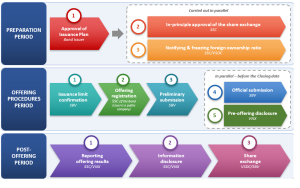
- WHAT ARE INTERNATIONAL EXCHANGEABLE BONDS?
According to the laws of Vietnam, repayment of international bond principal (which, in nature, is a foreign loan) by exchange into shares of a company held by the Bond Issuer (borrower) is permitted[1].
In line with market practice, the exchange right attached to International Exchangeable Bonds usually has the following characteristics:
- The exchange is at the option of the bondholders. The bondholders may opt to exchange the bonds into shares held by the Bond Issuer or to receive the bond principal on the maturity date. As such, International Exchangeable Bonds differ from convertible bonds[2], in particular the target shares used for the exchange are not issued by the Bond Issuer;
- The exchange right may be exercised by the bondholders during the exchange period, from the bond issuance date until before the maturity date (“Exchange Period”);
- Before carrying out the exchange, bondholders are still entitled to receive interest on each interest payment date in accordance with the bond terms and conditions;
- The exchange price and exchange ratio are usually determined on the pricing date and may be adjusted upon the occurrence of dilution events affecting the target shares (such as dividend distributions, divisions, separations or mergers of the company…);
- The number of target shares used for the exchange will be determined on the pricing date, based on the total issuance value divided by the exchange price;
- The exchange right is exercised on a non-cash basis; accordingly, the Bond Issuer’s payment obligations under the bonds shall be set off against the bondholders’ obligation to pay for the target shares.
II. NOTABLE POINTS PRIOR TO ISSUANCE OF INTERNATIONAL EXCHANGEABLE BONDS
In order to carry out a successful issuance of an international bond in accordance with the laws of Vietnam, the Bond Issuer needs to clarify the following key matters during the preparation period:
- What specific steps are involved in the registration process for offering International Exchangeable Bonds under the laws of Vietnam and how long it takes (if the Bond Issuer is a public company, obtaining internal approvals will be more complicated and time-consuming);
- How the cooperation and administration procedures among state agencies shall be managed to optimize the implementation timeline. The registration for offering securities in the international market shall be carried out with the State Securities Commission (“SSC”), applicable to a Bond Issuer that is a public company. The registration of the foreign loan, control of the national limit on self-borrowed, self-repaid foreign loans as well as registration of the foreign loan and debt repayment account to receive proceeds and repay bond principal and interest shall be carried out with the State Bank of Vietnam (“SBV”). In addition, the Bond Issuer shall need to carry out procedures with competent authorities (Vietnam Securities Depository and Clearing Corporation (“VSDC”)) to record and transfer the ownership of target shares from the Bond Issuer to investors when they exercise the exchange right;
- How the compatibility and differences between the domestic regulations (Law on Securities, Law on Enterprises) and the regulations of the target international market (Singapore, Hong Kong, London…) shall impact the arrangement of the deal structure.
III. CONDITIONS AND IMPLEMENTATION SCHEDULE
- Preparation period
1.1. Passing the Issuance Plan and preparing transaction documents for a bond issuance
The Bond Issuer needs to prepare the issuance plan (“Issuance Plan”) which fully contains items according to Article 10 of Decree 200. The Issuance Plan must be approved by the competent body of the Bond Issuer in line with its Charter. Unless the Charter provides otherwise, the Board of Directors is entitled to approve the Issuance Plan but must report to the General Meeting of Shareholders (“GMS”) at its next meeting[3]. Furthermore, the Bond Issuer needs to obtain approval from competent bodies in the international bond issuance purpose. The issuance purpose must be compliant with the regulations, including implementing investment projects in the investment forms prescribed under the Law on Investment, restructuring the enterprise’s debts and other purposes as stipulated under specialized laws[4].
In addition, the Bond Issuer must also satisfy the conditions for offering non-convertible bonds without warrants in the international market, including: the Issuance Plan having been approved by the competent body; the Issuance Plan having been approved or accepted by the competent state authority where the issuer engages in a conditional business line under specialized laws, and the issuer meeting the financial safety ratios and operational safety ratios under specialized laws; compliance with regulations on the management of foreign borrowing and debt repayment and on foreign exchange management; and satisfaction of the offering conditions of the target market[5].
Besides the Issuance Plan, the Bond Issuer needs to prepare transaction documents for an issuance following the law provisions and practice of the target market. As usual, the international bond package shall comprise the main documents: prospectus, terms and conditions, subscription agreements, underwriting agreements, bondholders’ representative agreement (trust deed), security agreements (if any), guarantee agreements (if any), account management agreements (if any).
1.2. In-principle approval of the SSC on the share exchange
As described in Part I above, the exchange of International Exchangeable Bonds into target shares shall be exercised based on (i) non-cash payment and (ii) exchange price and exchange ratio as agreed in the bond documents. As such, the ownership transfer of target shares to bondholders of International Exchangeable Bonds has to be implemented outside the stock trading system of Vietnam Exchanges (“VNX”) and be approved by the SSC. For such reason, the Bond Issuer has to seek the in-principle approval of the SSC on the general exchange mechanism applicable to the entire International Exchangeable Bonds (since the exchange may take place multiple times from time to time). Currently, the procedure for seeking the SSC’s approval is stipulated under Circular 119[6].
1.3. Notifying and freezing the foreign ownership ratio of target shares
As the holders of International Exchangeable Bonds are foreign investors, their exercise of the right to exchange the bonds into target shares will increase foreign ownership in the company issuing the target shares (“Target Company”). Therefore, the Target Company needs to calculate the ratio of the maximum number of shares to be exchanged, assuming all International Exchangeable Bonds are exchanged, over the total number of outstanding target shares (“Frozen Ratio”), in order to carry out freezing procedures with the SSC and VSDC and ensure that the exchange does not breach the foreign ownership limit applicable to the listed shares of the Target Company. Concurrently, the Target Company has to publish information on the maximum foreign ownership ratio (or the adjusted ratio) according to regulations on information disclosure on the stock market[7].
- Procedures for offering International Exchangeable Bonds
2.1. Submitting the application for SBV’s confirmation of the issuance limit
Submission timing: the step will be carried out after the Issuance Plan and proceeds usage purpose from an issuance are approved by the Bond Issuer’s competent bodies in line with Section III.1.1 and before the Bond Issuer registers the offering of International Exchangeable Bonds in the international market under Section III.2.2 below (if applicable)[8].
a. The Bond Issuer submits to the Foreign Exchange Management Department of the SBV[9] an application for confirmation that the value of the international bond issuance falls within the total annual limit of self-borrowed, self-repaid foreign commercial loans approved by the Prime Minister. The application comprises the application form for registration of the international bond issuance and the documents specified in Article 6 of Circular 10, except for the documents to be submitted under Section III.2.4.
b. Within 07 working days from the date of receipt of a complete and valid application, the SBV shall issue a written confirmation or refusal of confirmation of the issuance limit (“Limit Confirmation Letter”)[10]. The Limit Confirmation Letter is a mandatory component of the offering registration dossier submitted to the SSC and a condition precedent for the Bond Issuer to proceed with the subsequent procedures.
2.2. Submitting the registration dossier for offering bonds in the international market to the SSC (applicable to a Bond Issuer that is a public company)
Submission timing: the Bond Issuer submits the dossier at this step (i) after receiving the Limit Confirmation Letter, (ii) after filing the offering registration dossier with the competent authority of the target market (if required by the laws of the target market), and (iii) after the Board of Directors or other competent body of the Bond Issuer has approved the registration dossier for offering bonds in the international market[11].
a. The Bond Issuer must submit the application for registration of the offering of bonds in the international market to the SSC. The components of the dossier are specified in Article 24 of Decree 200. Notably, the dossier must include either the offering registration dossier filed with the competent authority of the target market or a legal opinion of an international law firm confirming that the Bond Issuer is not required to register with the competent authority of the host country for the bond issuance.
b. Within 07 working days from the date of receipt of a valid dossier, the SSC shall notify the receipt of the dossier and publish on the SSC’s website that the issuer’s complete dossier has been received[12].
2.3. Pre-offering information disclosure to VNX
At least 01 working day prior to the commencement date of the bond offering (being the date on which bond subscription monies start to be collected from investors)[13], which is usually the closing date of the issuance (Closing), the Bond Issuer sends the pre-offering information disclosure to VNX in the prescribed form, including the expected offering period (being the period for collecting bond subscription monies from investors), the account number for receiving bond subscription monies and the organizations involved in the offering. The disclosure must be accompanied by relevant documents, including the original or a certified copy of the bondholders’ representative agreement and a written confirmation from a commercial bank or foreign bank branch that the issuer has opened an account for receiving bond subscription monies.
For a Bond Issuer that is a public company, the Bond Issuer may only send the information disclosure after the SSC has notified the receipt of the complete dossier under Section III.2.2 above.
2.4. Submitting the registration dossier of the international bond issuance to the SBV
At this step, there are 02 submission milestones, namely the preliminary submission and the official submission, as follows:
a. Preliminary submission
b. Submission timing: after the Bond Issuer has agreed on the draft agreements with the underwriters, agents and legal counsel involved in the issuance; after the bond offering registration dossier has been received and published on the SSC’s website under Section 2.2 (if applicable); and before the pricing date[14]. The bond pricing date (“Pricing Date”) is the date on which the Bond Issuer and the bond subscribers agree on the interest rate applicable to the bonds and the volume of bonds to be issued[15].
c. At this step, the Bond Issuer needs to prepare and submit to the SBV the final drafts of the following documents (“Preliminary Dossier”)[16]: copies and Vietnamese translations of the agreements relating to the issuance containing information on the terms and conditions of the bonds, the collection of bond proceeds, the payment of bond principal, interest and fees, the organization acting as the lenders’ representative, and the agents involved in the issuance structure; and foreign-language copies and Vietnamese translations of other contracts or agreements to be signed between the Bond Issuer and foreign parties that impose fee payment obligations in connection with the issuance. Notably, all fees and service agreements payable by the Bond Issuer to the relevant parties should be fully listed as the basis for remitting foreign currency to such parties. Such fee-bearing contracts and agreements may include: legal service agreements with international law firms, and agreements with the listing agent, the bond depository agent, the printing agent, and the fiscal and paying agent. Within 09 working days from the date of receipt of a complete and valid Preliminary Dossier, the SBV shall review it and request clarification (if necessary)[17].
d. Official submission
e. Submission timing: after the competent body of the Bond Issuer has approved the specific terms and conditions of the bonds, after the agreements in the Preliminary Dossier have been officially executed by the relevant parties (“Official Dossier”)[18], and before the date on which the Bond Issuer starts distributing the bonds and collecting subscription monies from investors (usually the Closing date).
f. Procedures: the Bond Issuer finalizes the registration dossier and submits it together with the Official Dossier to the SBV. If the executed agreements differ from the drafts previously submitted to the SBV, the Bond Issuer must send a written report clearly specifying the changes between the executed agreements and the final drafts in the Preliminary Dossier. In case the details of the issuance set out in Part III of the application form for registration of the international bond issuance submitted under Section 2.1(a) above are changed by the results of the issuance, the Bond Issuer must update the application form and submit it to the SBV. Within 02 working days from the date of receipt of the Official Dossier, the SBV shall issue a written confirmation of registration of the international bond issuance[19].
- Post-offering obligations for International Exchangeable Bonds
3.1. Reporting the offering results
Within 10 days from the end of the international bond offering[20], the report on the offering results, which includes, among other things, the number of bonds distributed, the total value of bonds distributed and the total proceeds raised from the offering[21], must be sent to the SSC (applicable to a Bond Issuer that is a public company), and the notice of the offering results must be sent to VNX (applicable to a Bond Issuer that is not a public company). In addition to reporting/notifying the offering results to the SSC, the Bond Issuer must also disclose the offering results to VNX.
3.2. Periodic and ad-hoc information disclosure
After completing the offering and throughout the term of the bonds, the Bond Issuer continues to perform periodic and ad-hoc reporting and information disclosure obligations relating to the bonds (such as payment of interest and principal, early redemption, and changes in the outstanding principal after each exchange), and periodically reports to the SBV on the implementation of the foreign loan[22]. Information disclosure obligations under the regulations of the target market, the bond listing venue and the bond terms and conditions are beyond the scope of this article.
3.3. Exercising the right to exchange International Exchangeable Bonds into shares
During the Exchange Period, bondholders may exercise the exchange right by sending an exchange notice to the designated notice recipient (in accordance with the bond terms and conditions). The relevant parties then need to carry out the following procedures:
a. The competent body of the Bond Issuer (the GMS or the Board of Directors, as provided in the company’s Charter) issues a decision approving the transfer of ownership of the target shares, and such decision is publicly disclosed;
b. Foreign bondholders need to open an indirect investment capital account, register for a securities trading code and open a securities depository account (if not yet available) to hold ownership of the target shares[23];
c. Where the exchange triggers a mandatory public tender offer under the Law on Securities, the bondholders must carry out the public tender offer procedures (including the relevant reporting and information disclosure obligations) before receiving the transfer of ownership of the target shares;
d. The Bond Issuer/Target Company releases the frozen shares as described in Section III.1.3, corresponding to the number of target shares exchanged;
e. The Bond Issuer, through the depository member holding the target shares, submits to VSDC an application for transfer outside the VNX trading system on the basis of the SSC’s in-principle approval as described in Section III.1.2[24];
f. If the exchange results in a bondholder becoming a major shareholder holding 5% or more of the voting shares of the Target Company, such bondholder must carry out reporting and information disclosure procedures[25];
g. If the Bond Issuer is a major shareholder of the Target Company and the exchange of shares to bondholders results in a change in its shareholding crossing a threshold of 1% of the voting shares, or results in the Bond Issuer ceasing to be a major shareholder, the Bond Issuer must also carry out reporting and information disclosure procedures[26];
h. The Bond Issuer notifies the SBV in writing of the share exchange resulting in a change in the bond principal amount, without having to register such change[27].
————–
[1] Article 34 of Circular 12/2022/TT-NHNN of the State Bank of Vietnam dated 30 September 2022 guiding foreign exchange management for foreign borrowing and debt repayment of enterprises, as amended and supplemented by Circular 80/2025/TT-NHNN of the State Bank of Vietnam dated 31 December 2025 (“Circular 12”).
[2] “Convertible bonds” are bonds that may be converted into ordinary shares of the Bond Issuer itself in accordance with the terms and conditions specified in the bond issuance plan (Article 4.3 of Decree 200/2026/ND-CP of the Government dated 5 June 2026 on the private placement and trading of corporate bonds in the domestic market and the offering of corporate bonds in the international market (“Decree 200”)).
[3] Article 23.2 and Article 10.2(a) of Decree 200.
[4] Article 5.2 of Decree 200.
[5] Article 23 of Decree 200.
[6] Article 6.3 of Circular 119/2020/TT-BTC of the Ministry of Finance dated 31 December 2020 on the registration, depository, clearing and settlement of securities transactions, as amended and supplemented by Circular 18/2025/TT-BTC of the Ministry of Finance dated 26 April 2025 (“Circular 119”).
[7] Article 13.2 of Circular 96/2020/TT-BTC of the Ministry of Finance dated 16 November 2020 guiding information disclosure on the securities market, as amended and supplemented by Circular 08/2026/TT-BTC of the Ministry of Finance dated 3 February 2026 (“Circular 96”).
[8] The confirmation of the issuance limit is tied to the total annual foreign commercial borrowing limit approved by the Prime Minister. Therefore, if the issuance is postponed to the following year, the Bond Issuer may have to re-apply for such confirmation.
[9] Article 7 of Circular 10/2022/TT-NHNN of the SBV dated 29 July 2022 guiding foreign exchange management for the issuance of international bonds by enterprises without the Government’s guarantee, as amended and supplemented by Circular 78/2025/TT-NHNN of the SBV dated 31 December 2025 (“Circular 10”).
[10] Article 4.7 and Article 7.1(b) of Circular 10.
[11] Where registration with the competent authority of the host country is not required for the bond issuance, the Bond Issuer needs to obtain a legal opinion from an international law firm confirming such exemption.
[12] Article 27.2(b) of Decree 200.
[13] Article 4.10, Article 27.2(a) and Article 35 of Decree 200, and Article 25 of Circular 138/2026/TT-BTC of the Ministry of Finance dated 25 September 2026 guiding certain articles of Decree 200.
[14] Article 7.2(a) of Circular 10.
[15] Article 3.5 of Circular 10.
[16] Article 7.2(a) of Circular 10.
[17] Article 7.3(a) of Circular 10.
[18] Article 7.2(b) of Circular 10.
[19] Article 7.3(b) of Circular 10.
[20] For international bonds, the subscription monies are usually paid in a single payment on the closing date of the issuance (Closing); therefore, the commencement date and the end date of the offering usually coincide.
[21] Article 27.2(d), (dd) and Article 36 of Decree 200.
[22] Articles 36 and 37 of Decree 200 and Article 41 of Circular 12.
[23] Article 138 of Decree 155/2020/ND-CP of the Government dated 31 December 2020 detailing the implementation of certain articles of the Law on Securities, and Article 4 of Circular 03/2025/TT-NHNN of the SBV dated 29 April 2025 on the opening of Vietnamese dong accounts for foreign indirect investment activities in Vietnam.
[24] Article 48 of Decision 07/QD-HDTV of VSDC dated 3 February 2026 promulgating the regulation on the registration and transfer of securities ownership at VSDC.
[25] Article 31.1 of Circular 96.
[26] Article 31.2 of Circular 96.
[27] Article 9.2(e) of Circular 10.
————-
Disclaimer: This article has been prepared by PTN Legal LLC (“PTN Legal”) for the sole purpose of providing reference information to readers. PTN Legal makes no representation or warranty as to the accuracy or completeness of this information. The contents of this article may be changed, amended, or updated without prior notice. PTN Legal assumes no responsibility for any errors or omissions in this article, or for any damage arising from the use of this article in any circumstances. Please visit PTN Legal’s website to view our previous articles here.
Readers who wish to receive articles from PTN Legal by email may register their information here.
This Article was prepared by Yen Pham, Senior Associate